Outdoors Winter Workout – Prepare For The Unexpected

Outdoors Winter Workout – Prepare For The Unexpected


When I say training outdoors I don’t mean only running. I mean taking all your workouts outdoors, the whole thing.

There are so many things to consider when we workout outdoors in winter. Prepare for the unexpected as best as you can. Particularly in winter when the weather is cold and it can get dark in a matter of minutes, but not only, all seasons have their challenges.

However, no matter how much I or anyone tells you it is you who have to discover. It’s part of the game.

But I will give you a number of things to think about:

  1. Temperature – do you need layers? Base layers, compression shorts and shirts etc. 
  2. Less daylight – do you need a head torch?
  3. Weather conditions: fog, rain, snow – do you have water resistant jacket prepared? Or layers such as neoprene vests when temperatures drop below 0 degrees Celsius.
  4. Where you run – on the streets, in the woods? What do you need? Maybe reflective kit, head torches to be seen and see.
  5. Ground conditions: wet, muddy, slippery, snow, frost – this will determine the type of shoes you wear. I personally have 2 types of shoes: one pair for when the ground is muddy and slippery and another pair for dry seasons. You can find recommended shoes here.
  6. Water and snacks – although it is not hot out there the body uses so many resources to keep at a stable temperature, dehydration is sometimes worse. Use a water belt.
  7. Equipment – besides layers and head torches do you need:
    • gloves (fingerless or with fingers?)
    • beanie hat (don’t want your ears to get cold)
    • a Buff neck warmer (instead of a scarf)
    • calf warmers and arms warmers (they are compression equipment)
    • socks (bear in mind socks get wet and you will keep that for the whole duration of the session, I trained myself to go without socks)
  8. Be informed – check weather report and know when the sun rises and sets
  9. Id card and your phone – you know why you need these, in case anything goes wrong you can call and/or you can be identified.

Walkabit in Oxted 24th nov 15

Things you may not have considered when working out outdoors in winter.

Training outdoors is all awesome and fun, but things can go wrong, and we need to be aware of the environment we interact with.

  1. Keep your eyes on the ground as well as seeing everything else around and above you. Develop your peripheral view.


  1. Gone are the days when you were in a gym worrying about nothing allowing yourself to day dream. When you are outdoors you have to be focused, otherwise you end up with a branch in your face and a foot in a rabbit hole.


  1. If you are in a forest pay close attention to falling branches and dead trees. This is for any season.


  1. Take small steps and go slow when unsure. Better to slow down instead of slipping on ice under snow or stepping in a hole you can’t see under the mud or a puddle.


Do you have questions? Or are unsure how to workout outdoors in winter or any other season? Contact me and I will guide you.

Equipment For Outdoors Winter Workout

Equipment For Outdoors Winter Workout


These are the main pieces of equipment you should consider having through winter training.

Of course it also depends on what winter we are talking about. Does it snow, how low does the temperature go? In this case I will talk about London, where winter temperatures are around -5 degrees Celsius.


Clothing and shoes


Layers

You may get hot, you may get cold, you don’t know. You might want to take layers off, if you don’t have them you are stuck. Be prepared.

Base layers

Base layers regulate your temperature and keeps moist out. When we didn’t have them we were ok. But now that we have them put them to good use.

Arms and calf compressions

It is said that compression layers help you reduce muscle strain. In winter they also keep your muscles warm, reducing risk of injuries.

Shoes

I don’t know about you but we train on muddy terrain and having a good grip is essential. If you are a runner and run on pavement think about slippery surface and if there is any snow.

If you go off road, make sure you have the right shoes. We use Inov8 and Vivobarefoot for winter.

Beanie hat and gloves

You can lose a lot of head if your head is uncovered. This is not fashion, it doesn’t matter whether you look good with a beanie hat or not. If you are doing a photoshoot fine, look as you want to. But when you train outdoors you have to keep warm.

Hands are the most exposed to the elements. Get a good pair of gloves, fast wicking, that will keep your warm.

Good quality stuff

Don’t go for cheap stuff. With few exceptions, in general, you get what you pay for. If you are serious about outdoors winter workout treat yourself to good equipment.

In the long run you will actually save money.


Food and liquids

It’s not summer, it’s not hot but winter weather will take up a lot of resources. Make sure you sip water throughout your workout.

Add a pinch of salt to replace electrolytes.

Have snacks such as fruit leathers and bars. I don’t particularly eat bars, I usually have a piece of fruit with me. Here’s what to look for in the ingredients list when you choose your bar.


Other pieces of equipment


Head torch

Depending on the time of day you will do your workout you may start or end it before sunrise or after sunset.

I began training with head torches in 2012 with my coach. What an amazing experience.

Backpack

You have quite a few pieces of equipment to carry with you. Plus the layers. Have a good backpack. We use Lowe Alpine 18l. You can find models on the UWF Amazon store.


I think I have covered the essentials. If you have questions post them in a comment below.


We are affiliates of Amazon store, but not to a particular brand. So you will find various brand for equipment, snacks and books on health, fitness and personal development topics. Access the store here.


If you’d like more advice contact me and I will be happy to give you some more suggestions.


How To Prepare For Outdoors Winter Workout

How To Prepare For Outdoors Winter Workout


Training outdoors in winter is a matter of experiencing the world from a different angle. There are a few things about the environment to consider when you take on winter training.


Temperature

You know it’s cold already, but knowing the temperatures will help you with more than just on the day.

You learn about your body, how it behaves at certain temperatures, what it needs and when it is time to push cold weather conditioning, if that is what you want.

You also keep track of your progress in terms of changes in your overall body temperature as your body acclimatizes to harsh weather.

Knowing the temperature will help you decide on the type of kit you will be using. And knowing how your body is accustomed to certain temperatures you will know that when others feel cold for you it’s comfortable, or the other way around.

Numbers are your guidelines.


Environment

Temperature is one aspect. The other is whether it’s wet, dry, foggy, raining or snowing, muddy or ice under the snow. So the ground and general weather conditions.

Knowing this will help you decide on the layers you will wear, the type of shoes you will wear and other accessories you may need.

Don’t over think things. You don’t need 100 pairs of shoes and layers. Have one main kit for winter and one for summer. In the next blogs I will be talking about winter training equipment.


Timing

When we workout outdoors in winter we must not forget it gets dark earlier and the sun rises later. Now it’s light, 45 minutes later is dark.

If it gets dark while you are in the park or the forest it can get dangerous, for both men or women.

I was lucky to have been coached by an experienced coach and learnt what to look out for.

You must time your workout to make sure you are well equipped. A head torch with you is one of the best pieces of equipment to have in winter.

1. EXPERIENCE THE WORLD FROM A DIFFERENT ANGLE

Contact me if you are in need of more advice.


How To Train Outdoors This Winter

How To Train Outdoors This Winter


The previous article was on why you should ditch the gym this winter. Now I will share with you 3 ideas of how to train outdoors with winter.


1. Running

If you choose to go without and experiences coach, although you should consider it, running is the easiest way to begin with.

Mind that there is a running technique to run on wet or muddy surfaces or through snow and over ice. That’s why I advise working with an experienced coach who specialises in outdoors training. This is what I specialize in, so contact me.

However, here are some tips to consider, whether there’s mud or snow:

– keep your feet underneath your body

– small strides

– go slow

– don’t push off the back foot, lift the foot off the floor

Actually all four conditions are met if you keep small strides.

3. Think Live And BreatheOut Of The Box

2. Ditch the gym equipment

Leave the gym in the box, you are outdoors now so you leverage nature. Not in a bad, disrespectful way, not at all. You can use equipment such as longs and rocks for weight training for example.

Don’t use benches. Honestly, when I see people in the park using benches for step ups, why are they even outdoors.

Get creative and think outside the box.


3. Get your hands dirty

Want to condition your spirit and mind? There is nothing more wonderful than crawling on the ground with no gloves on. Your hands will get cold, but they will condition.

Besides, in London, winter is not as bad as in other parts of the world.

Cold is a matter of perception. Like walking over fire or walking on broken glass, don’t try these as home though. Physical conditioning is about getting the body used to certain temperatures, or a certain training routine.

Mental conditioning is about getting the mind to see things from a different perspective.

That doesn’t mean you hands have to go numb, but a little cold will only get the blood moving. Get gloves if it’s too bad, in time your body temperature will adjust.

The topic of one of the upcoming blogs is how to prepare for outdoors winter training and what to do after.


This winter, think, live and breathe outside of the box.

As usual, contact me if you need more advice or want to discuss more on the topic.


Why You Should Ditch The Gym This Winter

Why You Should Ditch The Gym This Winter


A few years ago I used to only run, all year round, outdoors. On snow and ice, rain and heat. The last few years have witnessed a massive shift in my training methods, my fitness in general and my coaching style and philosophy.

I am talking about a different type of fitness. I am talking about fitness that, besides getting you really fit, it also teaches you many, many lessons, about yourself, your body and it give you the chance to reflect.

So why am is so set on outdoors training? Here are a few reasons that might convince you that training outdoors is one of the best decisions you would ever make, and training outdoors in winter:


Different kind of fitness

A couple of months ago I pulled a muscle. I’ve been through it before so I know how a pulled muscle, and even pulled tendon, feels like.

A pulled muscle takes weeks to heal. I was shocked at how fast my body heals these days. In 3-4 days I could walk without limping and within 1n week I was recovered and ready to get back to my training routine as usual.

Now this is the kind of fitness I am talking about. For me and my clients fitness now means: cardiovascular and strength (including weight training) BUT it also means:

– training the body from all different angles; terrain is never the same, you never o the same exercise, every time you place your foot or hand on the ground muscles work in a slightly different way, strengthening from many different angles

– get the body prepared to withstand and recover faster from things such as sprains, pulled muscles

– awareness

– increasing the body’s natural healing abilities

– understanding the basics of biomechanics, just enough to understand why some things are good for the body and some are not

And these are only some of the benefits of training outdoors. You can learn these in the gym as well. But nothing compares with the diverse, wavy terrain, when you walk and run. It teaches you a lot about your body.

But what does this have to do with winter? This leads me to the next point:

5. Winter - IT'S TIME TO PUSH YOUR BOUNDARIES - Copy5. Winter - IT'S TIME TO PUSH YOUR BOUNDARIES - Copy

Challenge your body

Winter is not comfortable. It pushes you out of your comfort zone in many different ways.

First there is the physical as in cardiovascular and  strength. Training in harsh conditions takes a lot, a lot of energy. Maybe it will not make you sweat but you WILL work really hard.

Second, is at the mind level. Waking up at 5 am and going out there on rain or snow is not easy and it is not for the faint of heart, as the saying goes. The reality is that this is not for everyone.

Don’t get me wrong. Absolutely ANYONE can do this, except the people who want to be comfortable in a warm, and nice environment such as the gym or their house.

The mental strength, the dedication to your outdoors winter training will impact absolutely ALL areas of your life. Period. All of them: social, work, business, self esteem and self confidence, they way you present in front of audiences and so on.

Third. The unwavering spirit. THIS is the substance. The elements that we cannot easily see. Honestly I find it difficult to explain how outdoors winter training conditions the spirit. It’s such a deep and complex concept.

Meditation, while we do it, it’s not what I am talking about. I am talking about the spirit of a warrior. That’s the only way I can describe it.

What I can say is that outdoors winter training is the most important element in my life and that changed everything. The way I interact with people, they way I see and love myself, my self confidence, my ability to stand up for myself.

It changed the very essence I am made of. Sounds weird right? There is no other way I can explain it really.

BUT, there is a catch. Do the same exercises you do in the gym and the magic disappears. The trick is to adapt your training to the outdoors and do things in a different way, and not in the comfortable way. This is the topic of the next blog.


Bottom line. Outdoors winter training will condition your body, your mind and your spirit to a level you have never experienced before. This was my experience after training indoors for many, many years.

This winter push your boundaries. Contact me for more information on how to start your winter training program


Why You Should Stop Punching Bags And Pads

Why You Should Stop Punching Bags And Pads


Punching. A simple act of striking something with your fist. But is it really that simple?

After training in different Martial Arts for the past 20 years, Karate Shotokan in particular, competitive but keeping the traditional path when not competing, I can say I have learnt how to punch in a way that protect my body and injures the body of my opponent if choose to do so.

And one of the things I have learnt in these 20 years of punching anything from a human body to walls and tree bark is that you should never, ever punch anything until you know how you punch in the air, how to hold a fist, how to use your whole body to punch and until your body is prepared.

Doing a few kickboxing sessions, particularly the ones focused on high intensity training and weight loss, is not enough to learn this.
If you learn a superficial technique, superficial results is what you will get.

boxer

THE WHY

Why I don’t agree for most of you to punch bags and pads at the gym. There are many reasons:

1. No matter how much weights you lift your body is not accustomed to the impact of punching another object and if your body has not adapted to the correct technique you will be using your body in the wrong way which damages the body.

2. For every action these is an equal and opposite reaction.

We get so caught up with punching and releasing stress, we hit the pads as hard as we can, with the wrong technique and unprepared and we burn calories but at what expense? Weight comes and goes, a damaged body is more difficult to heal, if it ever heals.

Remember is it the pressure at the wrong angle, the wrong technique, that damages the body.

3. Focusing on high intensity for weight loss means forgetting technique, if there was any to begin with, and in time injuries start to show up.

If you punch bags and pads and your shoulder or elbow start hurting chances are it’s from your punches.

4. If the elbow goes out the impact is even more destructive. Nerves can be affected.

5. If you punch from your shoulder, you will damage your shoulder. Read bellow for a few guidelines.

6. In those bulky boxing gloves few people even know how to actually hold a punch.

Do you know? Did anyone with real experience teach you how to hold your fingers? At Every Karate session we practice the simple punch over 1000 times. Yes, we did the numbers.

Learn how to hold a punch, the wrist, the elbow, how to move the arm, how to use the body and then, only then you can think about gloves and pads.

There are other reasons, but I will stop here.


THE HOW

And now few things you should know, practice and repeat thousands of times before you start punching pads and bags:

1. Learn how to hold a fist without the gloves

2. Punch using the two first knuckles: index and middle fingers.

Even when you do a round punch, which, by the way you should learn how to do it properly so you don’t damage your shoulder, the rotator cuff.

Most of the gym people and PT’s don’t know how to punch properly. Study boxers’ movement and you will see.

A “boxercise” qualification and a few years of punching pads does not mean someone knows how to punch or teach.

I am sure there are trainers out there who come from a Martial Arts background and how how to punch and teach it correctly, no doubt about that. There are.

3. Wrist is on the same line as the arm and first

4. Elbow should stay down, the twist comes from the wrist.

See Japanese Karate masters. This protects the nerves going down the arm.

5. Arm never goes out to the side.

A beginner’s mistake when working with pads. You can do a round punch without the arm going out to the side. This protects the shoulder rotator cuff.

6. The punch must come from the back heel.

The force starts at the heel, goes up to the hip, side of your body, arm and out through the fist. A punch does not come from the first, arm or shoulder.

7. Body is kept straight.

Distance can be achieved through different tactics. Body alignment should always be taken into account to minimize the muscle tension and stress on stabilizer muscles.


What about professional boxers and Karate competitors?

When you compete you trust that your training was enough to get your body through the stress of usual movements, twists, bends and aggressive impact.

If, when you train, you nurture your body, in competition your body will be ready and will respond to the training.

If body alignment is a habit for you then you will carry that with you on a street fight or competition.

I know this because I used to focus on training hard and fast. Now I train harder, faster and smarter than ever before.

I have made greater progress in 1 year in England than in 10 years with my former Karate squad. Yes, correct body use which came through others sports and forms of training, is that powerful. Just because I brought the elements of efficient body use and mindful control into my Karate.

I have reduced the risk of injuries and when I do injure myself I can get back to training in a matter of days.

Thus, make sure you actually learn how to punch and then punch bags and pads. Same goes for kicking, which is actually worse, I haven’t seen anyone doing a correct kick outside martial arts classes. Maybe because we all focus on burning calories instead of looking after our bodies and learning something properly


Punching in a correct way is something easy to teach, the pure technique. Although I do not teach Karate yet I am certainly qualified, as a 3rd Dan Black Belt to teach you this.

I can teach you the correct technique over a 30-45 min call. Contact me to book the FREE call and I will show you how to punch in the proper way.

How To Strengthen Your Body Starting With Foundations

How To Strengthen Your Body Starting With Foundations


Six packs, toned triceps and strong thighs look nice. There is no doubt that strong quadriceps, glutes, core muscles are essential, they are stability muscles in the body.

What I was to talk about today is the difference between looking strong and actually being strong.

When they look at me, many people don’t realize that one of my kicks or a punches can actually cause them a lot of pain.

I don’t look particularly strong, but the foundations are strong and when everything comes together there is a lot of power behind a fist.


Alignment

Today we are very focused on strengthening the larger muscle groups such as glutes and hamstrings. And yes, they are really important as they are stabilizer muscles.

However, we are missing something. Something really important. We are missing the small muscles in our bodies. Just because we don’t see them or they don’t bulk up that doesn’t mean they are not there or they are not important.

Furthermore we also talk a lot about posture and we focus on core strength. Which, again, it’s essential. But how can you strengthen your core in the wrong position?

What I mean is this. We have developed an incorrect body alignment as a consequence of sitting, slouching, looking down to our phones to text, leaning to one side when we talk on the phone,  carrying our bags on one shoulder and so on.

Our body is in an incorrect position to begin with. So why strengthening it in that position?

What I recommend before anything else is understanding how you should hold your body, proper alignment, first of all.

Then, with that alignment in mind go ahead and strengthen your core muscles….in the correct position.


Joints

Every joint has a position where it’s at its strongest.

For example your wrist in the case of a punch. If the wrist is slightly bent up or down, when you punch it will give in and maybe even injure it, or even fracture it, depending on the impact.

I disagree with punching against a pad for beginners. That is why, although I come from a Martial Arts background, Karate Shotokan since 1995, I never do this with my clients.

A punch is so much more than just throwing it in a pad or bag. And those round punches that PT’s teach their clients damage the shoulder, the rotator cuff. Plus how someone who has never punched before hold their wrist. Ok, I will stop here and write a separate blog about it.

Another example are the knees when you run. There is repeated pressure on the knees. The angle at which the impact falls is the one that decides whether there will be an injury or not.

Pressure is there but it’s the angle the pressure falls on that damages most.


Strengthen from the inside

After you become aware of body alignment begin working on your deep core stability muscles: diaphragm, pelvic floor etc.

You will not be able to isolate these muscles but what you can do is practice techniques which targets them. For example the crawls I do with all my clients.

They are safe on the back and strengthen the inner/deep core muscles as well as other stability muscles in the body.

Balance techniques are also a great way to strengthen the deep core muscles. Not only that, balance exercises strengthen the small stability muscles in your joints.

So your joints strengthen starting with deep foundations. And the slower you go the better with these type of exercises, particularly at the beginning.

Alexandra

Fast or slow?

I think one of the most overlooked element with all exercises today is the speed at which we practice the exercise.

Plyometrics (explosion) exercises are very important, particularly for runners. Muscles need to fire up. So they should be in your workout plan if they aren’t already.

What plyometrics overlook is the small stability muscles which strengthen through slow movement. Movement that requires stability.

Let’s face it, everyone can do things fast, but how many can slow down to a snail’s speed? Now that’s control over your body.


One whole unit

Your body is designed as one unit. Don’t make the mistake of thinking that running is only about the legs and lifting or punching only about the arms.

A strong punch comes from your feet. It involves the whole body, not just the shoulder. Maybe I will explain how this work in a video rather than writing.

Everything you do is more efficient if you use your body how it is meant to be used. In a correct way of course. If you use your whole body and it’s not correct then we’re not getting anywhere.


Do you need more personalized advice or would like to go into more detail? Contact me.

The 4 Ingredients Missing In Your Workout

The 4 Ingredients Missing In Your Workout


I used to work in a gym. I am very grateful to have been part of the Virgin Active PT team. I learnt a lot.

I used to walk around the gym floor for hours and hours, about 50 hours a week without clients, was walking on the gym floor. I approached and talked to hundreds of people and coached them as well.

One of the things I would ask was something like “why do you do this routine every time you come here?” or “why do you exercise?” or” do you enjoy what you are doing?” and so on.

Many times the answers would be something like: “I do it because it’s healthy“, “I do it because I was told it’s good for me“, and the best one was “I am bored of it but I still do it“.


Don’t we do things we don’t like or want to do every single day? Why, after spending 8 hours in front of the computer, we choose to be surrounded by even more electronic devices and spend another couple of hours in another box getting bored and doing something because we have to do it.

Don’t get me wrong, since I was 1995 I’ve been practicing Karate and competing at international level. This sport, if you want to call it so, it’s not something superficial, it’s not a “I feel like training today” thing, nope. It’s a responsibility.

But, the difference is that Karate is my thing. It’s what gives me life, what makes me feel like a champion and actually be a champion. Yes,  it is something I have to do, but it is something that makes me grow as an athlete, coach, entrepreneur and as a human being.


It’s substance, there are no superficial layers. There is passion, there is life in what I do. Is there life in your exercise routine? These are the things missing in peoples’ workouts. And here’s how to bring some substance into your workout routine.


In terms of substance, just like Karate, the outdoors make no exception. When you train outdoors you start feeling alive as you actually interact with the world surrounding you.

How come you will never get bored training outdoors? I can only talk here about my own programs, other Personal Trainers have other methods and many just take the exercises from the gym and bring them outdoors.


Here’s how we do things here at Urban Women Fitness through The Merisoiu Technique:

1. You repeat but not really.

Our sessions vary from session to session. There are elements, the basics, we always go through but the main theme of the session changes. In a 3 months, 12 sessions of 1h30m, program you practice 6 different type of sessions.

In some instances you work the same muscle groups but in a different way. So you repeat the training but not the same session.

Practice makes perfect so a certain degree of repetition, particularly the basics, is necessary. There is so much you can do in 3 months though.


2. Different environment

Today you train in the sun tomorrow it’s a snow storm. Every session is different form a weather point but also how the ground feels and looks.

Even if we go back to the same location it’s going to be different from yesterday. That means you will work your body in a different way. Which is a good thing.

There are many physical and mental challenges with this change in weather, all aimed I conditioning your body, mind and spirit, so you get stronger from the inside out.

The Merisoiu Technique

3. A practice, an art

Exercising for weight loss or fitness is boring. Hunter gatherers didn’t stay fit because they were concerned with their fitness. Athlete, we don’t keep fit because we want to stay slim. That’s comes with the practice of our art, or because hunters needed to hunt.

The Merisoiu Technique was developed with this in mind, not the hunting part though. It is a lifelong pursuit and here we strive for mastery.

My clients focus on the process of perfecting their movement or their sequences and, in the process, they get fit, toned, healthy and lose weight as well.

Develop patterns that you can gradually get better at. The feeling of accomplishment will keep you going and not get bored.


4. Feel alive.

Just what I’ve been talking about at the beginning. That substance we, as society, have forgotten about. We focus so much on fashion, trends and how we look in bikinis that we forgot the outside reflects the inside.

I like to look good in my bikinis, but most than that I like to feel proud and confident in my own skin. The bikini will look good after I feel good in my skin.

What does that even mean? We all see this in a different way. I can only tell you my view of feeling good in my own skin.

For me it means to feel strong. To feel grounded and in control of my body and that includes any type of movement, posture, breathing, everything. But those things comes as a result of what’s going on inside of myself.


So what does “feeling good in your own skin” mean to you?

Have questions or in need of advice? Contact me.

The Secret IngredientTo Turn Your Boring Workout Into Purposeful Training

The Secret Ingredient To Turn Your Boring Workout Into Purposeful Training


Substance. That’s what is missing and so many Personal Trainers forget to educate their clients on.

My knowledge comes not only from the gym, or from Karate, no, it comes from Daito Ryu, Ninjutsu, Tai Chi, Qi Gong, Target Shooting, Swimming, Latin American Dancing, and more more more.

There is more that meets the eye and there are things you cannot learn from a book.

For fitness and exercise to turn into purposeful training you need that SUBSTANCE. That’s the secret ingredient that makes many hate exercising or only do it for weight loss or only because they were told they “have to do it”, or only because “it’s good for your health” etc. And after a few months or a year they give up.

Of course they do, there is no substance in what they are taught to do. It’s not their fault though.


So how do you get substance?


1. Passion

If in your fitness or exercise routine there is no passion, no love and excitement then it will not work. You don’t need to like the training itself, you can only like the results.

But even so do what you do with passion. I know sometimes when I go to my Karate class or even think about it I feel like coming up with the best excuse ever for not going.

Sometimes it’s the last thing I want to do (shhhh don’t tell my Sensei). But I do go, and when I am there, maybe I don’t give 100%, but what I give I give with passion. Whether it shows or not I feel it and that’s the secret.


2. Purpose

Goals are great and they are a must but what’s the purpose, what’s behind those goals, that’s what will keep you going when the tough gets tough? What are you going to do when you see results not showing up or they show up slower than you expected?

Because that happens. If getting results was that easy everyone would get them. Purpose!


3. Skills

We are build to learn and grow. If we don’t do something that makes us grow we will not do it for a long time. And you waste your time as well. Develop skills, learn patterns, study your body, learn complicate movement sequences and you will fall in LOVE with your training.

I have personally developed movement sequences for my clients and they challenge their minds. That is substance.

champion


4. Champion.

This is what wraps up everything. Do the thing that makes you feel like a champion. Train like a champion. Be as dedicated as an elite athlete. Eat as healthy as an athlete. Have the mindset of a champion. Because there is an athlete in you, you are just an untrained athlete.


Missing something? Let’s figure it out together.

Things To Do Under The Shower

Things To Do Under The Shower


It’s not what you think ok? It’s about stretching.

Too many of us “complain” we have no time to stretch. Well, beginning today you can incorporate stretching in your other daily “must do” habits.

And for stretches, doing them under the shower is actually good as they release tension faster and they are also warm and ready for a stretch.

Some safety stuff: showers are slippery so you might want to sit to do some of the stretches or all of them so you don’t injure yourself.


So here are a few things you can do while you shower


Be mindful of your posture

Hahaha, thought you got away. Nope, the more aware we are of our posture and body weight distribution the better.

So stop slouching. Relax your shoulders. What makes the greatest changes in life are the habits you do when no one is watching.

It’s difficult sometimes to hold your posture, I know very well. But if we want to make any difference in the way we feel we must make an effort, just at the beginning until the habits become automatic. It will be worth it in the end.

Read my blog post on Posture: 3 Awesome Benefits Of  A Great Posture


Stretch your toes and fingers…one by one

This the the best feeling ever. And it’s not only me saying this. My clients and my readers stretch their finger and toes and they feel amazing as well.

Imagine your fingers all day tensed after tipping, carrying, throwing, catching and, in my case punching. Toes are the same, curled up in shoes (particularly high heel shoes…ouch!), walking, running. They need to stretch and relax.


Stretch your wrists

Pretty straight forward:

– bend your wrist and push one at a time with the free hand, to feel the stretch on top of the wrist

– palm facing up, push the fingers and palm down and pull them towards you, to feel the stretch on the opposite side

– palm facing down, pull the hand towards you (slowly); elbow tucked in; drive your thumb towards your body

– palm facing down, pull the hand towards you (slowly); elbow tucked in; drive your palm and little finger towards towards your body


Breathing exercises

Here I actually have a chapter of my upcoming book, Breathing Mastery, available for free download. 

Take the linear and triangle breathing techniques and practice them.

And if you want to know why correct deep breathing techniques are important, check out my blog: 16 benefits of deep breathing. Among them we have:

  1. Relaxes the mind and brings clarity, focus, allows room for more creativity and productivity.
  2. Helps detoxify your body.
  3. Relieves emotional struggles, calms you down in moments of panic and anxiety.
  4. Assists in weight control. More oxygen to your tissues burns up the excess fat more efficiently.
  5. Improves cellular regeneration.
  6. Encourages good posture. When you slouch notice how your body closes up and your breathing becomes shallow. Then you take a deep breath, your chest comes out and your body naturally straightens.


Stretch the sides of your body

I have a couple of pictures of you here:

Alexandra-Merisoiu-Flexibility-Exercise (10) Alexandra-Merisoiu-Flexibility-Exercise (11)


Stretch your neck

Alexandra-Merisoiu-Flexibility-Exercise (7) Alexandra-Merisoiu-Flexibility-Exercise (6)
Alexandra-Merisoiu-Flexibility-Exercise (8) Alexandra-Merisoiu-Flexibility-Exercise (9)

Stretch your forearm, shoulder and triceps

Alexandra-Merisoiu-Flexibility-Exercise (2) Alexandra-Merisoiu-Flexibility-Exercise (3) Alexandra-Merisoiu-Flexibility-Exercise (1)

Stretch your shoulders and chest

Alexandra-Merisoiu-Flexibility-Exercise (4) Alexandra-Merisoiu-Flexibility-Exercise (5)


The Merisoiu Stretch (of course)

I must remind you here about safety on slippery surfaces. You can do this after you come out of the shower, better.

Should You Hurt After Your Workout?

Should You Hurt After Your Workout?


What is Delayed Onset Of Muscle Soreness or DOMS?

DOMS is that discomfort, or muscle ache or soreness, that occurs 24-48 hours after activity. Although I must say that some experts agree on 12-72 hours after activity.

Either way it happens to everyone, fitness beginners and elite athletes.


Why DOMS happens?

“Delayed onset muscle soreness (DOMS) is a common result of physical activity that stresses the muscle tissue beyond what it is accustomed to,” says David O. Draper, professor and director of the graduate program in sports medicine/athletic training at Brigham Young University in Provo, Utah. “Small microscopic tears occur in the muscle”.


Do you need to feel sore after your workout?

The aches and pains are a sign that the muscles are adapting to the new training routine, exercise or movement.

Adaptation means your muscles are making progress and they will perform the movement easier the next time you do it.

Hurting really bad doesn’t mean you worked really hard, rather it means that the movement or exercise you did is new for your body, it is strange and it needs to get accustomed to them.

DOMS does not indicate how hard you’ve worked. This is just a misconception. Your session can be really easy but very new and still get sore muscles the day after.

As mentioned before, it does indicate that your body is adapting to the type of training routine or movement. There is progress.

swimming

Variation

When you do the same things over and over again you plateau. Your muscles adapt to certain specific movements, or very similar, and those exercises become more comfortable to perform.

However, you are not made of a few main sets of muscles: quadriceps (thighs), hamstrings, gluteus maximus, triceps, biceps, trapezius.

To continuously develop your all round muscle strength you should cross train.

That means you vary your training. For example, let’s say you are a runner. Variations can be:

– cycling

– mobility and flexibility

– swimming

– strength training

– balance and body weight transfer

– rock climbing


And so you develop your muscle strength all round. You may get sore muscles if you do something new; that’s something you haven’t done at all for a couple of months. But that’s normal.


How to reduce muscle soreness

You cool down is the most important. This includes about 10 min of light aerobic training such as light jogging and then stretch, I’d say about 15 min of all body stretching.

Get some inspiration from Urban Fitness Academy visitors section.

Other options include: rest, ice, massage, heat.

I personally go with stretching.


Conclusion

Although we love to feel that pain because we get excited that we got results, the truth is no results occur over night. But sore muscles can tell you that in fact you are working the muscles.

On the other hand you should feel your body and be aware of which muscles work during your session and not based on the pain you feel after.

If you don’t feel pain the day after your session that does not mean your workout was a waste of time.


It is important to  make the difference between moderate muscle soreness induced by exercise and muscle overuse or injury. To know when when, for example, you are experiencing muscle soreness and when you have overstretched or pulled a muscle.

Oh…and if the soreness prevents you from doing daily activities that is too much and this will prevent you from continuing training. Not to mention some beginners end up hating it all together.

10 Reasons Why You Should Have Your Own Personal Health Coach

10 Reasons Why You Should Have Your Own Personal Health Coach


Have you ever asked yourself whether or not you need a coach? If so, here are a few reasons why a Personal Health Coach can be a good idea if you want to get results. It will also help you decide whether you need one or not. Not everyone needs a coach and coaching is not for everyone.

1. Consistency and accountability!

I will begin with these 2 because they are essential to get lasting results. You will see your Personal Coach weekly, or maybe even more often and they will make sure you get things done to get results. And even if you make mistakes they will be there to guide you back on track.

Your success is your coach’s success.

Personally I keep in touch with each of my clients in between the sessions, asking them how their week is going, if they did the routine we have chosen for them to do, what they struggles are and so on.

And those who are committed to transform their lives do the work, make time and make it possible and they do get what they seek.


2. Trusted source of information

We do our research. We study, test and learn. You have access to all that information, so you don’t have to waste time on reading everything on the internet.

Furthermore, there are things you cannot learn from a book.


3. Saves you time

It takes time to come up with exercises and routines to get the best results. If, for example, you do the same routine at some point you have to change it or you will stop making any progress and you might actually regress.

See my blog on the adaptation process to better understand what I am talking about.


4. Gets results

There is a reason athletes have coaches. As athletes, although we know a lot about our sport and we can actually coach others, we still need coaches. Because you cannot push yourself harder than someone else can push you.


5. Gets results….safe

It is important not to compromise aesthetics for a healthy body. What I mean is that too many of us focus on weight loss at our body’s expense.

Remember that weight will always go up and down, but once you damage your body it takes years to heal. In some cases certain injuries never heal completely.


6. Out of your comfort zone

You can only take yourself out of the comfort zone so far. And if you are not taken out of your comfort zone you will never get results.

If what you do doesn’t make you grow stop doing it, there’s no point doing it.

[tweetthis]If what you do doesn’t make you grow stop doing it, there’s no point doing it.[/tweetthis]

Urban Women Fitnes - The Merisoiu Technique

7. Attention and care

Having a Personal Coach it’s…well…personal. You and your coach will get to know each other very well.

Your sessions together are not limited to the 1h-1h30min a week but you talk in between your sessions. That’s how you get long lasting results, by having someone who cares guiding you.

Your coach will create a training program that will take into account your goals and aspirations but also who you are as a person.

8. Saves you money

You may think not, particularly if it’s an expensive coach, however your personal coach can teach you how to care for your body inside and out.

They coach you smart, keeping you away from injuries and they can give you tools you will be using for a lifetime, that will save you money on physiotherapy sessions, diets and all sorts of things you really don’t need once you establish strong foundations.

My Sensei once told me that when someone asks for a certain amount of money, which seems a lot, that means there is always something more than the eye can see. In some cases this is spot on.

9. After coaching resources

You personal coach may have online resources so when you finish your personal coaching together you have everything ready for you to continue by yourself.

For example I give my clients lifetime access to the UWF Academy which follows 12 weeks of weekly training, food discipline, technique guides, meditations and more.

And they can do these programs over and over and over again. This is very valuable as they can do things by themselves and not always depend on someone else.

10. Motivation and support

When the tough gets tough many people give up, they reset and then have to start all over again. Remember, consistency is key to make progress and get results. Those who have their Personal Coach are less likely to give up.

There is someone there behind you to push you forwards and walk the journey with you. Of course you can cancel your sessions but will you? I am pretty sure you will not.

When you give up you reset and have to start all over again, if you continue no matter how difficult it gets that’s how you get the results. And how do you keep going when you want to stop? Yep, that’s right, you have a Personal Coach before you even get to that stage.

This Is Why You Feel You Are Not Making Progress

This Is Why You Feel You Are Not Making Progress


The reality is we all go through them. You know, the dips. Those moments that can last for days and weeks, where you feel you’re not getting anywhere, you just want to kinda “take your toys and go home”. You feel you’re not making any progress, or even worse you feel you are regressing!!

What a horrible feeling! Especially when you work really hard to get those results.

But you know what, if we didn’t have those dips we would never see any progress in the first place, in anything. Whether it’s training, or a new diet or a change in lifestyle habits, or even building a business and a brand, believe it or not. Entrepreneurship takes you through the same process.

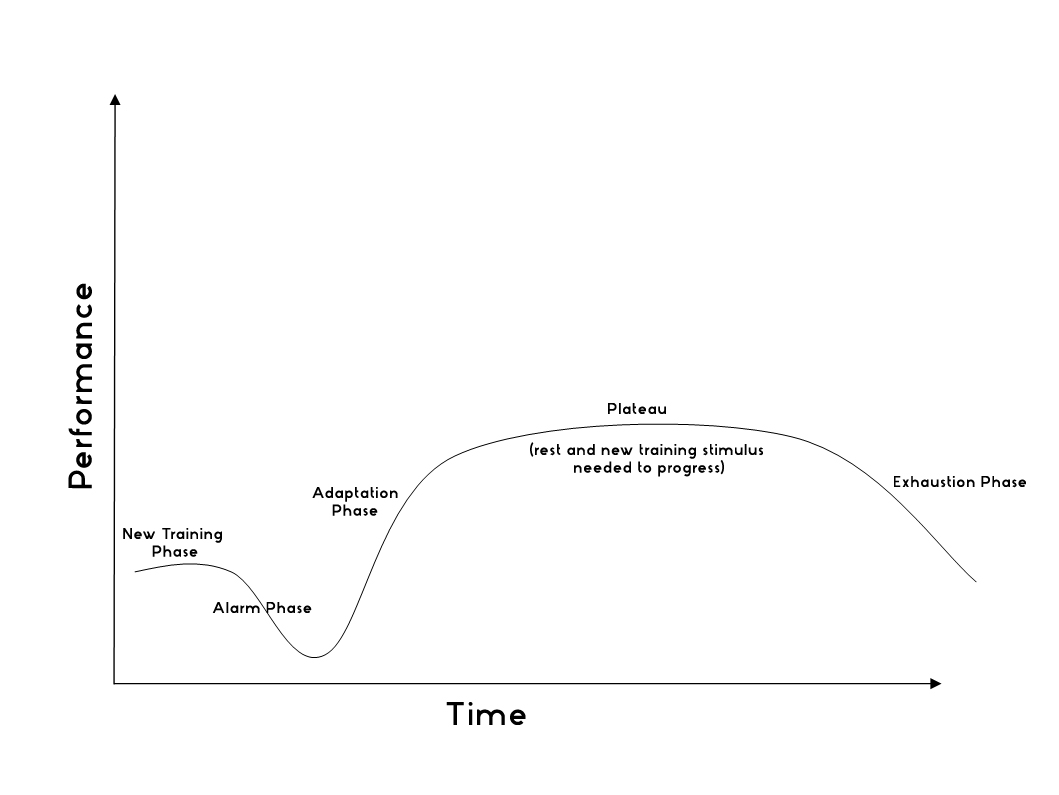
And actually it’s those dips that make you grow. What happens is the adaption process. And this is how it works:


The Stimulus

This is your new training routine or you come back after months or years of not training.

And even if you have always been training when you start a new, intensive routine, that’s the stimulus that starts the adaptation process.


The Alarm Phase

The alarm phase follows the beginning of your training routine, or a new training routine, the initial stimulus.

This is where you feel you’re not going to make it. It’s difficult to push through. But that’s also when the adaptations in the nervous system occurs. It’s the first stage of adaptation.

Any stimulus will initially lead to a decrease in performance in the alarm phase. And this phase can last for days or weeks. During this period, you may experience fatigue, stiffness and soreness and a temporary drop in physical performance. Some confuse this with over training. Nope, that comes later and only if you keep doing the same things without changing anything, there are certain conditions.

The alarm phase is a must as without it we would not have the next stage, the adaptation phase. You must go through the alarm phase.

By the way, this is when most people give up. Whether we talk about a new diet, lifestyle or training routine, when the tough gets tough here’s where most give up. But if you push through it you reach the next stage.

women running

The Adaptation

If you “survive” the alarm phase adaptations begin to occur.

This is where your nervous system has adapted and you begin to notice muscular and aerobic adaptions. This is progress in performance.

There are also skeletal adaptations taking place and that is why it is essential not to grow the muscle mass too much too fast, to allow the skeletal changes to take place as well. Otherwise it will lead to joint damage. Slow progress is the best. It’s about building strong foundations first.


The Plateau

We’ve all heard about the plateau. You know, when you adapt to a certain routine and you stop making progress, or make very small progress.

It’s part of the adaptation process and unless you give the body another routine, to stimulate adaptation again, it will only be a maintenance program. You’re not getting anywhere when you hit that plateau.

Furthermore if you stay for too long in the plateau your performance will slowly begin to decrease as you reach the exhaustion phase which can lead to over training. This is where over training can occur.

This is where you need a scheduled break. By break I mean you either do a type of training like balance and fluid movement or do a different sport like swimming if you are a runner. You don’t just stop for a few weeks and do nothing at all.


The Exhaustion Phase

This is critical. You see so many gym enthusiasts doing the same routine for months, some even for years without changing much or anything at all.

Continuous exposure to the same routine, or stimulus, will eventually lead to overtraining. This is due to the inability of the body to tolerate the cumulative stress of the same stimulus over a period of time.

This is why I always say variation is key.

The exhaustion phase is characterised by a decrease in physical performance, as well as monotony, soreness and fatigue.

So the aim is to keep the body in the adaptation phase as long as possible. And to do this you need:

– periods of rest scheduled into the programme – remember rest doesn’t necesssarily mean you sleep all day and do nothing

– stimulus to be changed on a regular basis


This is how the process looks:

adaptation.

Technical Plateau

This is an element of the plateau which although it is not part of the adaptation process it’s something I’ve experienced in my athletic career and as a coach. And I’ve seen it in other sports people as well. Or rather heard about it.

The technical plateau is when you feel you just can’t get it right. You are still making progress in terms of adaptations, as we discussed above, but technical wise it feel weird and unusual. You just can’t get it right no matter how much you try. It’s like you have just lost your mojo, you know what I mean?

This is normal. It’s similar to the alarm phase. And what follows the alarm phase? Yep, adaption and progress. At some point you just get it right and it feels perfect.


So what do you do when you feel like you’ve lost your mojo?

1. Have patience

2. Focus on the process, on your training regime,  rather than on how things are not working out right that moment. Do your very best.

3. Have a coach, who can tell you what’s happening and who has been and/or goes through similar experiences and is familiar with the 4. phases. I believe a coach should go through all the stages themselves to be able to guide others through them.

4. Know that, if you coach says your techniques is fine, you are just in a dip and when you come out of it, in a few days or weeks, you will witness great progress.

5. Vary your training. For example I look to do something else than Karate, like Obstacle Racing. When you train and focus too hard on one thing, in my case the World Championship, you stretch yourself too much. You stretch like a rubber band and there so much a rubber band can stretch. It needs a bit of slack as some point.

I’ve been an athlete since 1995. Can you imagine how many adaption processes I went through? And they are never the same. But it’s beautiful to come out on the other side and see the massive progress. And this also helps me understand the different phases my clients go through and I am able to guide them accordingly


The same process applies to a new diet, implementing habits in your life, getting a new job, becoming an entrepreneur, moving from one country to another. You go through the initial alarm phase, adaptation and then plateau.

In terms of diet and healthy habits however, you want to reach the plateau, that’s where it gets comfortable and your body has adapted to the new types of food and new habits. Simple right?

Now that you understand how it all works you will not give up after a month or two of training or trying something new right? You know you are going through the alarm phase.

Are you going through any alarm phases or plateaus and not sure how to get through them? Are you stuck? Book a FREE call with me and let’s see how you can get through it.

Why I Am Not A Personal Trainer

Why I Am Not A Personal Trainer


Who would have thought that the knowledge about the body learnt after thousands of hours spent in the Dojo training for Karate competitions and teaching will be the foundations of my coaching today.

Everything from breathing, posture and meditation to developing a strong, flexible and healthy body as well as knowledge about bones, tendons and muscles were ingrained in me from an early age. All I needed to do is fill in the gaps through studying and experimenting on myself and form a complete system: The Merisoiu Technique.


So why am I not a Personal Trainer?

I was a PT for the beginning of my career in the health and fitness industry. As a PT I used to help my clients lose weight, tone up, get fit, gain muscle mass as well as nutritional advice.

I loved it. I loved it until I realized that I had so much more to give my clients. And I wasn’t. I couldn’t give what I wanted and the way I wanted. I wanted to transform my clients’ lives by addressing the foundations and personal development.

Now as a Coach I not only help my clients with their physical appearance and wellbeing but change the way they live their lives.

I don’t coach my clients to get fit and healthy for the summer, I coach them to be fit and healthy for the rest of their lives. And we do it by addressing the root cause of their imbalances and slowly changing habits, starting with the smallest ones.

My clients leave my programs with a lot of knowledge about their bodies and how they function. They receive intrinsic knowledge which they cannot learn from a book. This comes from years and years of experience. In essence it’s a Personal Development journey.

I wanted to introduce my clients to a new way of living life. So I transitioned from Personal Training to Transformational Coaching…outdoors

[tweetthis]I wanted to introduce my clients to a new way of living life.[/tweetthis]

Alexandra Merisoiu Shotokan Shield Open Karate Championships

The roots of The Merisoiu Technique

So when I created the system, The Merisoiu Technique, it was because my clients wanted to get fit, strong and powerful. However they also needed to understand how their bodies function, how to move soft and fluid and how to prevent injury as much as possible. And it was essential not to sacrifice the later for the former.

It was imperative for them to understand the difference between tension and relaxation, intentional movement, posture and balance and counterbalance. The Mindful Control component is where my clients learn to bring together or to align body, breath, and mind. And then to catapult their results we brought in the physical and psychological benefits and the freedom of training outdoors all year round. Benefits such as strength and emotional balance. And of course the nutrition and healthy habits part.

Finally, it became clear that my clients needed to have access to a complete system which would offer them the foundations they needed to live a healthy and fit life for the rest of their lives. Once you understand the basics of movement, posture, breathing, nutrition and Mindful Control then you actually become in control of your own life, for the rest of your life.

All in all The Merisoiu Technique involves coordinated movement, breath, and awareness, building a strong and fit body and learning how to implement healthy habits and nutrition. It’s about building the foundations of a healthy lifestyle and reclaiming your nature.

Alexandra Merisoiu Watch Fit

The principles of The Merisoiu Technique

The Technique covers five main areas of health and wellness:


Earthing

It is no coincidence that The Merisoiu Technique is an outdoors system of Personal Development which takes place all year round, be it hot, cold, freezing or rain.

I believe nature is the most powerful force. And when you train with natures elements you become as powerful as the elements. Well…almost as powerful. It’s perfection to strive for. However they do make your stronger than you have ever thought you could be.

One of the elements of The Technique that many are afraid of is rain and winter training. What many don’t realize is that this is your challenge, this is what shows how dedicated you are to the way, the path you chose.

And this is when you strengthen your body and mind, more than in any other season. Winter is the season of breakthroughs for all my clients. You make it through winter training with me, you make it through almost anything else.


Natural Movement

Natural movement was created by Movnat Founder Erwan LeCorre. It’s training and conditioning the body through movement such as lifting, throwing, hanging, crawling, balancing, running, walking. So you will find natural movement element in this system as well.


Fluid Movement

I have personally development a range of fluid movement sequences based on my experience in Martial Arts. Imagine Tai Chi but different.

Fluid movement can be done very slow, slow, fast or very fast, it can still flow. The Merisoiu Technique fluid movement sequences covers all.


Mindful Control

Here we pay close attention to posture awareness, breathing mastery, attention and focus, technique and discipline.

This component also includes mindfulness and meditation practices.

There is a touch of Alexander Principles in the Mindful Control component


Habits Transformation

This component addresses any habits in your life that keep you from getting fit and healthy for life.

In general, with my client, we focus on nutrition,  food discipline, individual training routines planned weekly and meditations.


So you see, this is a complete system. It pays close attention to every detail of your life. From breathing to posture and daily movement.

Your training never ends in the forest we train, it goes beyond. You take this knowledge home with you and you transform your life. What I was doing as a PT could not be taken home, it was left in the gym and it was changing your body but it didn’t go much further than that.


If this sounds like something you desire I invite you to book a FREE call with me to go over the struggles you are facing and see what are the best options for us to work together.

8 Reasons Why Training Outdoors Is Less Stressful

8 Reasons Why Training Outdoors Is Less Stressful


We have too much stress and worry in our lives. If keeping our bodies healthy and strong has to be stressful as well then we are getting nowhere. It’s just…wrong.

So here’s why training outdoors is far less stressful, just a few of the reasons


1. Dirty shoes, or shoeless, doesn’t matter

When you enter the gym with dirty shoes you feel awful or other people staring at you make you feel awful. Outdoors no one cares, not even the squirrels. They can be full of mud for a month if you don’t feel like washing them up. In the gym you can’t go with dirty shoes, they would probably kick you out.

And you can’t take your shoes off either, healthy and safety regulations. And if you do, or others do, imagine the smell 😉 No stress.


2. Where will you go?

A problem I faced with my clients very often when I was a gym PT. If there is sweat on the floor how many option do you have? Yuck. How far can you go? In the outdoors if there’s dog poo here you just take two steps to the side and it’s clean. No stress.


3. No space to move

In the gym if you don’t like a corner of the gym you can only move a few feet away before you hit a wall. Outdoors you can run or walk for 10 min and you find a totally different place. Unique. No stress.


4. Too crowded

In the gym, when it’s busy you struggle to find your little corner to do your sit-ups. That or do them in the middle of the gym…if you have room. In the outdoors you have km of land, you can go anywhere you feel comfortable. No stress.


5. Too close for comfort

In the gym is someone moves around to much, like skipping rope, or pushing and smashing things against the ground they almost step on your feet or hit you.

In the outdoors there is room for anyone to do anything, wherever they want whenever they want, and you as well. No need to go around others to make sure you don’t get hit. No stress.


6. Rainy days

If it rains and you want to enter the gym you have to dry up first. In the outdoors the more it rains on you get the more incredible you feel. And no one kicks you out. No stress.
 

7. Things break down

In the gym is your favorite piece of equipment breaks down….or worse if someone sits there for half hour, you need to change your routine.

In the outdoors there is no equipment. And you don’t need any, to get and stay healthy and fit. All you need is your body and creativity. Lots and lots of creativity. No one will take that and it won’t break down. You just have to make sure your body, the only equipment yo need, will not break down. Ahhhh…No stress.

Photo Credit: martinak15 via Compfight cc

8. On your own terms

Don’t you hate it when you want to do an early morning training and have to wait for the doors to open?

The gym closes and opens at certain times…..that won’t happen outdoors. No stress.
In the outdoors you can do whatever you want (with respect for nature, law and oters around you) and whenever you want! Who’s up for 3am training? No stress.


In summary…

Outdoors you don’t have to be worry about being clean, how you smell, how you look, your makeup, huffin’ a f puffin’ or any other sounds you want and feel like making. Not worry about throwing stuff around, about people looking weird at you, someone interrupting your training to say “hello” or give you their invaluable advice. Or worse, trying to sell you stuff. No stress.

Outdoors you are you, you can be anyone you want, you can do whatever you want, within the rule of law and respecting others and nature.

Outdoors training doesn’t mean you do the same boring gym routines just outdoors. Outdoors you can train for strength, cardio, flexibility, mobility, endurance and you don’t even have run on the hamster wheel (aka treadmill). And it’s a lot more challenging.


Finally, training outdoors is freakin’ awesome! And if you have the right guidance, knowledge and source of creativity you will have the time of your life and awesome stories to tell your friends and family. Who will ever tell the story of how they ran on the treadmill.


Ready?

Do you feel in any way intimidated by the gym book a free call with me and we can come up with an outdoors specific training routine for you. Are you ready for this adventure? Let’s make you life awesome.

How The Practice Of The Merisoiu Technique Changes Your Life

How The Practice Of The Merisoiu Technique Changes Your Life


When you begin something and you stop after a few months, a year or even 2 you will never master it. And when you don’t master something you don’t receive the essence of it and you don’t grow.

You never receive the true value of what you do. And your progress never gets over a certain point before you choose start all over again with a new practice because you were bored of the old one or for other reasons.

Mastering one thing will automatically make you very good at many other things. If you are unable to master one thing then do you think that by jumping from one activity to another will help you master anything and be really good at anything?

If you cannot be dedicate to one path, how can you be dedicated to any path at all, in any area of your life. You cannot.

You must begin by mastering one thing before you move on to the next.

Don’t just play with your life, your habits, your passions. Dedicate yourself  to something and practice it, day and night. Then and only then you will see the true value of the lessons you are taught.

It’s not about how you slim you are, how fast and strong, it’s about dedication, loyalty and perfecting the art you are involved in.

It’s about daring to be the best you can be every day and every moment of the day.

The Merisoiu Technique was built with this in mind. It is not a fitness regime and just because it is outdoors that does not make it a bootcamp.

You will not do your usual reps and sets, press-ups and burpees and if you do they will be with a twist. We are here to challenge your mind not only your body.

No, The Merisoiu Technique is a process, a practice, a “way” for you to follow, dedicate time, be disciplined and learn to be consistent. It’s mastery.

It is an art by itself, built upon thousands of years of Martial Arts wisdom and techniques and modern coaching methods.

In return for your dedication and commitment, The Technique will open new doors for you, because it is a Personal Development tool. It strengthens your strengths and turns your weak points into strengths.

My clients who have been with me for over 6 months, some of them have been working with me for 2+ years, take the learnings into their daily life and it transforms everything they do, for the better.

The Technique is not meant to be practiced only in your session. It’s a practice that changes the way your live your life, for the better. It’s a transformation process rather than a change.

How you use your body and mind in your practice of The Merisoiu Technique will become the way you use your body and mind in all other areas of your life.

Finally, The Merisoiu Technique is an education system for your body and your mind. Master the elements of The Technique and you will find yourself in control over your emotions, thoughts, your body and over your life.

The breakthrough

It is no a coincidence that The Merisoiu Technique is an outdoors system of Personal Development which takes place all year round, be it hot, cold, freezing or rain.

I believe nature is the most powerful force. And when you train with natures elements you become as powerful as the elements. Well…almost as powerful. It’s perfection to strive for. However they do make your stronger than you have ever thought you could be.

One of the elements of The Technique that many are afraid of is rain and winter training. What many don’t realize is that this is your challenge, this is what shows how dedicated you are to the way, the path you chose.

And this is when you strengthen your body and mind, more than in any other season. Winter is the season of breakthroughs for all my clients. You make it through winter training with me, you make it through almost anything else.

what_is_TMT_harmonious_combination1

Transferable skills

The Merisoiu Technique is the way to train your mind and body, build strong, lasing foundations and then transfer them into your life.

When you learn discipline, dedication and consistency in one area of your life, the practice of The Merisoiu Technique in this case, then you will automatically implement them into other areas of your life like work or family. And so life is just a little bit easier.

The Merisoiu Technique tests your limits, so when you choose a path in your business or profession you will take that determination, dedication, consistency, that power and strength of mind and body developed through the practice and use them on that new path.

Once you follow a difficult path, that pushes you out of the comfort zone every single time, then all the other paths you choose become a lot easier to dedicate to, be consistent and make the greatest progress.

So if you are ready to know how The Merisoiu Technique can transform the way you move, breathe and live, jump on a free call with me.

What Is Efficient Body Movement and Why Should You Care

What Is Efficient Body Movement and Why Should You Care


Why you should care

First things first. First things first. Unusual way to start a blog but bear with me.

Your body and your mind are always connected. No matter what you do or when, they will always work together and influence each other.

When I began the journey of studying movement and teaching it I realised that the way I was using or carrying my body, my stances and my general physical state were influencing my state of mind and my emotions.

The same with some of my clients, particularly when we talk about stress caused by lifestyles, work environment, life events etc.

And this is more often than the opposite, although the mind influences the body as well.

However I noticed from experience and working with my clients that the moment we release physical stress release, psychological stress release takes place as well. And often this happens in a matter of seconds.

What is efficient body movement

I often speak about efficient body movement or body use. While my clients have a good understanding of what this means and most of them begin incorporating the elements from our sessions into their daily life, others don’t work with me so they do not know.

Everyone can move, everyone can run, everyone can breath, sit, stand and walk. No doubt about that. We do these day and night.

However efficient body movement or use is a healthy type of movement that nurtures the body, mind and spirit. It is the movement that enhances creativity, allows the mind to flow and the body to move with less restrictions.

It is the type of movement that allows all the functions of the body, internal and external, to function with as little resistance and restrictions as possible. It is the movement that allows you to thrive.

Your body is just like a musician’s instrument. You play that instrument. But unless you look after it and fine tune it you will not be able to make great music. It’s the same with your body, fine tune the way you use your body and it will function smoothly, with less problems and difficulties. And so will your mind as well.

[tweetthis]Fine tune the way you use your body to function with less problems and difficulties.[/tweetthis]

alexandra-8

Is movement only about the body?

No. It is my belief that a relaxed physical state will allow the body and mind to function at their best. When we do not use the body in a healthy manner there is a lot of pressure and many restrictions at all levels. Movement impacts everything else, it is not only about the body.

There are 3 reactions taking place in our bodies at any given time: PHYSICAL, PSYCHOLOGICAL and CHEMICAL (i.e. digestion).

[tweetthis]There are 3 reactions taking place in our bodies at any given time: PHYSICAL, PSYCHOLOGICAL and CHEMICAL[/tweetthis]

Whenever there is an “emergency” in one of the systems (i.e. stress) the brain directs most of the resources to deal with that problem.

The downside is that it takes the much needed resources for other functions. For example it takes the resources, the energy which deals with proper digestion. So stress leads to poor digestion, which leads to poor nutrients for the body, weight gain and so on.

Can you see what’s happening here? Any imbalance of any sort, in the body or mind, will cause the brain to focus on that particular function more and leave the others aside until that “emergency” is fixed.

But what about the body?

Here I’d like to give you an example using posture.

When we slouch and/or tense our bodies we compress our torso and place unnecessary pressure on our internal organs, as the body collapses forward and head hangs backwards.  And so the internal organs functioning is restricted.

And with restricted internal functioning, digestion is restricted as well as many other functions, but let’s stick with digestion, it’s easier to explain and understand.

If digestion is restricted then the body will not be able to extract the resources it needs from the food we eat.

When this happens our bodies cannot recover, nourish and thrive. And if our bodies cannot thrive then our minds will not thrive either. Besides what we eat and how we digest the food directly impacts the mental functions as well.

With restricted internal organ functioning, because of all the stress we place on them by slouching, many other problems arise at a physical, mental and emotional level.

What to look after

To achieve this balance, or rather to go back to balance, because your system will always try and get back to that, we need to look at the body and mind as one whole unit. They are not separate.

We need to address all three reactions taking place in our bodies at any given time: physical, mental and chemical.

So here’s a simple example on weight loss, because many people struggle with this.

“What is the reason I gained weight?
Is it lack of exercise – physical reacion?
Stress or depression – psychological reaction?
Nutrition – chemical reaction?”

Find the real cause. Because, for example, if your imbalance is caused by a psychological reaction you can tackle the physical and chemical as much as you want, you may even see results, but if you do not address the real cause, nothing will change, and the experience will perpetuate over and over again. Same goes for the other systems.

The brain will send all its resources to take care of that problem and that means it taking resources from the other parts. There’s your imbalance. Bring your body back to balance.

Allow yourself to thrive. Book a free call and I will help you with the first few steps.

What Does The Warm Up Actually Do

What Does The Warm Up Actually Do


A warm up simply brings your body into a state of readiness for the movements to come.

A warm up raises your heart rate, your body temperature and sends blood flow to the muscles to be used later on as well to tendons and ligaments. It also lubricates joints.

Remember the webinar I held where I talked about synovial fluid and fascia? If you haven’t seen it already you can request access here.

Benefits

Some of the benefits of warming up or preparing your body for physical activity include:

• reduced risk of injury

• increased flexibility

• better physical performance – you might have noticed that if you just start running the first 10-20 min are very difficult and then it gets easier; that’s because your body has warmed up

• better focus – you get into “the zone”; but this happens ONLY if you stop checking your phone, facebook and texting during your session (unless there is a good reason for it of course)

The warm-up is like a heater. Some heaters don’t heat up the room until they have reaches a certain temperature themselves.

Same with the body, the body needs to reach a certain temperature, flexibility and level of preparation to function at its best.

Components

1. Low intensity cardio – to raise your heart rate and body temperature
2. Dynamic movement – to mobilize the muscles, tendons and ligaments
3. Agility, acceleration, deceleration, speed drills – specific to your sport
4. Sport specific skills

mer-ka-bah-filming11

Guidelines for warm-up

• start with low intensity cardio

• start slow and build up

• do dynamic movements (for example this one) and not static stretches (static are the ones you hold for 10-15 sec and are for cool down section)

• mimic movements you planned for your main section of your workout or specific to your sport

• “wake up” your core – do a couple of planks, some pressups, squats etc

• but don’t fatigue your muscles – particulalry the core as you’ll be using this no matter what you plan for your workout, even if you isolate muscle groups

Mental preparation

Having your body is in one place and your mind in another is the recipe for injury.

The 7th Guiding Principle Of Karate-Do says that Calamity springs from carelessness. That’s just lack of awareness.

Throughout time I noticed that it takes about 20 min to get the mind out of the work – family – other things and into the present moment. So this is the warm-up.

This is one of the many reasons the sessions with my clients are 1h30min and not 1h , 45min or 30min. I put a lot of emphasis on being aware of what we do at any given point in time.

This being said, do you have a proper warm up set for your training? If you need advice and guidance book a free call with me.

How To Structure Your Workout

How To Structure Your Workout


You might think I’m just going to give you a routine. What I will actually do is make you think. I will give you the steps to create your routine but then you will do it by yourself. And then you can come to me with it and we can fine tune it.

Your workout is simply structured like this

1. Cardio warm-up – about 10 min

2. Warm up stretches. These not stretches you hold. They are movements that slowly stretch and unwind your body and which should mimic the exercises you have planned in your main section.

3. Main section. This is where you push really hard, your main workout. Around 30 min.

4. Cardio cool down – about 10 min. Here you can walk , slow jog etc

5. Cool down stretches. Here you can really stretch, holding the stretches for 10-15 sec and even give that box split a try. But be aware there are some basic guidelines for stretching to avoid injuries. However I will not discuss them here now.

Now, if you were to work with me you’d add the technical section as well, just before the main session.

Ok, cool, so this is it. This is how it looks. Usually training sessions last 1h but my sessions and those of my clients last for 1h30min.
Why? you ask. It’s simple. Before the “push hard” section we practice technique.

This ensured the body knows how to move and what to do in the most efficient way. This is where we build strong, long lasting foundations.

Furthermore the body and brain cannot just understand and fine tune movement after one try, so we are consistent and we repeat and build on the previous sessions.

I personally like to make my clients understand that training is more than just moving the body, it requires attention, focus as and fine tuning details.

We look at breathing, posture, general movement (what move before what so we avoid injuries) etc.

iphone-388387_1280

How to plan your session

1. Type of session. Decide whether you are doing a strength, cardio, endurance etc.

2. Strength session. What are you going to focus on? Upper body, lower body, core or full body? Then select 6-7, maximum 8 exercises. Depending on your focus you make the appropriate choices. If you do a full body you might want to consider alternating arms with legs, doing 1 arms exercise then 1 legs, or 2:2 etc. If your focus is on arms but want to bring some leg exercises in you can simply do 2-3 arms:1 leg.

3. Cardio session. This is usually characterized by speed training doing exercises such as sprinting, cycling or jumping and bring strength exercises in between. You can also do running intervals, or on the cross trainer (but that’s indoor and it can get boring). So here we also talk about power and explosiveness, getting your heart to beat faster.

4. Endurance. This can be done either by long duration training (running, cross trainer, cycling for long periods of time at a constant pace/speed) but also by holding positions for a longer time (planks for example, or squats). A mixture is the best.

Other stuff to consider

But wait, besides the general, basic structure outlined above there are a few elements to consider, again general knowledge.

1. Don’t fatigue your core. You will use your core muscles in almost everything you do. Even if you isolate muscle training you still use your core up, even if less. So make sure you don’t do intense core exercises at the beginning of your workout as it will fatigue and it leads to injuries. Save them for the main section and towards the end of your session.

2. …but you should “wake up” your core muscles, to get them going. Try doing some press-ups or planks. But not too many or for too long so you don’t fatigue. If you are not supervised by an experienced coach you can easily you can easily end up injuring yourself due to fatigued muscles.

3. Don’t overdo the cardio. Again you want to warm up the body not fatigue it.

4. Avoid brutal warm-up stretches. They should unwind your body, opening up the joints and releasing the muscles so they can stretch and contract easily.

5. “Calamity springs from lack of carelessness” (the 7th Guiding Principle of Karate-Do). This means that when your mind is not where your body is there is lack of awareness. And this is when injury happens. If you cannot focus and be mindful you should stop your routine and re-gain your focus, change your routine to match your state of mind or even stop and go home.

6. Resting. Athletes rest, they even rest for one whole week after a series of intense training sessions. Take one week off training ever 12 weeks of training or somewhere around there. This does not mean you stop moving, it means you do something else such as swimming if you are a runner, running if you are a cyclist, play squash, badminton, practice some Tai Chi etc.

7. Recovery between sessions. Allow for at least 1 day between sessions. This is a general rule but, depending on your level, your training purpose and your routine this can change. If you have a routine and you are unsure of how to plan your rest get in touch.

8. Be flexible. Your routine should allow for unforeseen circumstances. Injuries, emergencies, feel unwell etc can get you out of balance but you need to adapt.

Progressions

When you reach the plateau not matter how much you try you may not see any progress anymore so you need to make some changes. To change your routine get creative by addressing:

★ number of exercises
★ number of sets
★ target repetition range
★ recovery periods between sets (decrease, increase)
★ workout frequency
★ movement speed – slow to fast
★ different exercises
★ stable to unstable surface
★ simple to complex
★ split routines

Things to add you probably never thought about

These are some elements that very few consider and if they consider many don’t action them as it seems they are not useful, but actually they are the foundations. You are as strong as your weakest link!

1. Fluid movement
2. Breathing exercises
3. Flexibility and mobility ONLY sessions
4. Meditation
5. Barefoot or minimalist training (caution here, risk of injury)
6. Balance ONLY sessions
7. Training the foot muscles (strong foundations…)
8. Posture

So now let’s design your program, keep it simple, then you can work on it. Download the PDF document I created for you, a table for you just to fill in, and get started.

Are you stuck or need guidance on this planning? Jump on a FREE call with me and let’s create a program for you. I will also help you program your rest days and training for a month. Book here.

What Nadia has to say about her Urban Women Fitness outdoor training sessions

What Nadia has to say about her Urban Women Fitness outdoor training sessions


Nadia’s first session was in November 2014 in pouring rain.

Nadia has her own business, she is in her mid thirties, with two children and a family of three sisters that “come with emotional baggage!!” She finds it tough  getting the best out of her days, being effective and organised, juggling work-life balance, and it takes its toll on her as a person and without realizing she is “sinking”.


Her first session

Taking her workouts outdoors was a different approach Nadia had not tried before.  And she was the lucky one as the day of her first session was in November, so cold and very wet!  That did not stop the session from going ahead….and that certainly did not stop her from showing up.

It was raining and before we even started our trainers were completely drenched with mud so they felt very heavy!  Nadia’s mind at that point was busy thinking ‘what am I doing ‘ but she says that within minutes she stopped thinking and just followed my instructions.

“It was everything I wouldn’t and haven’t done before

…it was LIBERATING”


Jogging in the middle of the open field submerged with nature she absolutely loved it and more so because it was raining and cold, it made it more challenging.


“The ONE WORD I could use to express how I felt is ‘FREE’!”


How she transformed in just a few days

In her everyday life Nadia is always on the go, however during our sessions she can’t help it but relaxing her mind. It’s automatic.  

After leaving on that first session and going home, she found herself with a new mindset:

– more aware of her surroundings

– thinking with clarity

– not allowing situations to take over

– be more in control of her emotions


“I definitely felt lighter on my feet and my mind. What I gained from Alexandra through my sessions is priceless.”

And here’s a picture from our first session we took really quick after our session.

14 nov 2014 - Nadia

‘Engage your core’, what does that mean? Why should I do it?

flat-abdomen

‘Engage your core’, what does that mean? Why should I do?


crunch
Photo Credit: ShareHows.com via Compfight cc

‘Engage your core’, ‘suck your belly in’ or ‘squeeze your abs’ are terms repeatedly used by fitness professionals, including myself, but do we really think about what that means? Due to a limited time frame we never really delve into the benefits of building up a strong ‘core’ or how specifically to do it, in each training session.

So today I am drawing on my experiences as a gymnast, dancer and personal trainer to give you the low down on why you really should be engaging your core throughout exercise and how to do it.

Have you ever wondered how a particular dancer/gymnast/ice-skater effortlessly glides around the stage or floor? Well here is your answer in basic terms.


dance
Photo Credit: http://pixabay.com/

I have been taught from a young age in gymnastics and dance how to ‘shift my weight’, ‘stay on top of my supporting leg’, ‘find where my weight is’. All of these demands require you to connect your mind to your body. The individual tells their body to move a certain way and it responds correctly.

This is Mind-body connection is something innate to dancers and gymnasts. It is not, however, natural to everyone, which is why there is often difficulty when a non-dancer/gymnast is asked to engage his or her core.

So initially, I would suggest mindfulness as a useful tool for reconnecting the body to the mind, and incorporating breathing techniques into exercise.

girl
Photo Credit: martinak15 via Compfight cc

So once the individual manages to connect to their core, why should they focus their time on building strength in that area?

1. Keeps you graceful – It helps with your ability to control your movement, particularly when you come across a difficult exercise or you are starting to fatigue.

2. Back health – It is estimated that four out of every five adults (80%) will experience back pain at some stage in their life. Back pain is the number 2 reason for long – term sickness in much of the UK.(http://www.backcare.org.uk/factsandfigures).

The ‘Core’ is made up of a group of muscles that begin with your ‘abs’ and wrap right around to your back.

A strong core will support your back in times when it may be vulnerable to injury.

3. Power – A strong core is the starting point in powerful explosive movement, such as lifting and jumping.

4. Balance – Our bodies have the potential to do a lot more than we think. If ever in a situation where your stability is compromised a strong core will enable you or increase your chances of staying upright.

5. Light on your toes – If you ever start to feel fatigued and tired during exercise, your core is there to get you through and ensure that keep exercising effectively and efficiently.


But how do I do it?

I have found this to be the easiest way to activate connection to the core:
1. Start by lying or standing up

2. Place your hands on your stomach

3. Take a deep breath in allowing the stomach to balloon

4. Start breathing out feeling the abdominal muscles pushing the air out your lungs

5. Keep breathing out until your lungs are completely empty, to do this requires more effort then normal breathing and so you should feel your abdominals fully contract/tighten.

This exercise can be used as a core activation exercise or throughout your workout.

handstand1
Photo Credit: Evil Erin via Compfight cc

What’s my ultimate core strength exercise?

It has to be pike handstands (influenced by my gymnastic days). I love playfulness of the movement, challenging your body’s ability to respond to the movement quickly and you feel like you are doing something really impressive.

For those still building up core strength an easier, but equally impressive, version can be done by using a Swiss Ball to support the legs.


About the author: Alice BowmakerAlice Bowmaker


Alice is an East London based, YMCA qualified personal trainer on a mission to inspire and motivate people to push themselves past their expectations and help them rediscover their love for the beauty and strength of their bodies.

She has a background in dance and gymnastics which he uses extensively in her training repertoire. She also holds memberships with REPs and NRPT.

You can contact Alice at www.alicepteast.com