The Key To A Strong Immune System

The Key To A Strong Immune System


 alexandra merisoiu

Many times I am asked whether I catch a cold running in shorts and t-shirt in rain or snow, summer or winter. My answer is always no.

We do not catch a cold because it’s cold outdoors. No. We catch a cold when our immune system is down, that firewall. That’s when we are open to viruses and we catch that virus.

Your immune system can drop because of many different reasons. One of them could be intense training or cold. Yes. Cold can lower your immune system. However it’s not the cold that makes you catch a cold. It’s your weaken immune system.

However, if you keep your immunity strong constantly you needn’t worry about cold and intense training.


THE MISTAKE

There is a habit. The habit of inconsistency. You cannot have a strong immune system if you are not consistent with your eating habits, your training routine and sleeping patterns.

The “bad day, good day” stories are good excuses but the only one suffering will be you. In time, by confusing the body so much, its defense mechanisms will weaken and it will be more difficult to get them back up than if you were consistent from the beginning.

You may or may not be aware that what you do for months can cause those defences to gradually weaken, and not what you did yesterday. So running in the rain….no I don’t catch a cold.


STRESS AND LACK OF SLEEP

When I do catch a cold I know these are the 2 reasons that weaken my immune system a lot. I know because I pay close attention to my habits. Sometimes I even write them down.

Need I say more? Just that sleeping well (resting well, quality sleep is not the same as quantity) 3 days out of 7 or 20/30 doesn’t mean you are consistent. And don’t be surprised when you catch a cold because your body didn’t have the chance to recharge.

By the way, sleeping is the only time when the body heals in its natural way. Bear that in mind.


FUEL

This is one of the Food Discipline™ lessons I repeat over and over again.

Food is fuel. Leaving aside the cultural aspects and that it satisfies our taste buds, food is actually there to fuel our bodies and keep them strong.

Understand this, really understand it, and you will witness your food choice begin to change.


THE KEY

If you want to have a strong immune system be consistent with your (right) habits and drop the “good day, bad day” story. The right habits that build and help your body recover.

Recovery is not only after exercising. Recovery is after a day of work or looking after the kids. The body uses resources and it needs to recover.


There is no such thing as a good and a bad day, they are the reflections of your habits. Exceptions should be exceptions, and not daily and weekly habits.

Thus the KEY to a strong immune system is CONSISTENCY.


The KEY to consistency is, many times, ACCOUNTABILITY. If you struggle to stay consistent and want to get certain habits in place, habits that will last long-term contact me.

How Today’s Habits Will Impact Your Health Tomorrow

How Today’s Habits Will Impact Your Health Tomorrow


Many people think that the reason for my energy levels, my health and fitness condition, my mobility and strength is the young age. Yes, age is important and it does make a difference.

However, I ask you this: do all young people my age have high energy levels, strength, fitness and no health conditions, no vitamin deficiency etc? No, actually many people my age have big health problems. And in many cases they are caused by poor habits repeated on a regular basis over an extended period of time.

habits_bundle

For years I haven’t taken supplements and every year I do all my tests and nothing changes, no deficiencies, no internal organ problems. Just by being consistent with my habits and making exceptions very seldom. That is no necessarily true for everyone. Some need supplements and vitamins.

Remember this Food Discipline™ lesson: exceptions should be just that, exceptions. If you make too many exceptions they will become habits.

The real reason I am this way is because I have created habits for myself when I came out of eating fast food and drinking fizzy drinks. Read here about my story.

Since then I’ve been consistent in nurturing my body, keeping it strong and fit inside and out. Sure I cannot claim to be perfect and I make my exceptions, but I have rules and I respect my own rules. I wouldn’t have it any other way.

Don’t think now that I struggle and force myself into eating only certain types of food. No, not at all. I just go used to not having them that I never need them so it’s very easy for me to ignore them as food altogether. There is not struggle, no craving or strict regime.

Age does matter. But what you do when you are young matters even more. The things you do in your 20’s, 30’s and 40’s, those daily, weekly and monthly (un)healthy habits will impact our life in your 50’s, 60’s and 70’s.

I’m not saying that this is the case for every single person, but in many cases it’s long term small, damaging and overlooked habits that cause the greatest health problems.

Thus, stop postponing changing your habits. Stop finding excuses and making exceptions every day and every week. You only hurt yourself and no one else.

Of course you will not see the damage this year or next, look further into the future, you might feel the damage 10 years from now.
Build strong, lasting foundations which you can keep for a lifetime. This what I stand for.
And if you cannot do it alone then seek guidance.

Insight Into My Personal Nutritional Habits

Insight Into My Personal Nutritional Habits


I think every one of my clients ask me the same question at one point in our coaching journey: Alex, what do you eat?

So I thought I would write some of my habits and answer this question for them and everyone else. They are neither the best habits nor the worst. Choose the ones you believe can benefit you.

I will talk about things that I do and things I do not do in terms of nutrition. And I will try to keep it real and tell you about the less good things as well hoping you will find something to learn from this.


Consistency

I have sustained this type of diet and lifestyle for many years. A few exceptions were made when I moved from country to country, when the first 3-6 months were a struggle to adapt to the local food.

However, my body is very well adapted to this kind of diet and lifestyle. So if you try any of these habits and you find they do not work in the first 3-6 months that means that either your body needs more time to adapt or this is not the right thing for you.

Just bear in mind that a lifetime of poor habits takes more than just a few months to change and for the body to adapt. You need patience and perseverance, be committed to your daily habits and don’t make exceptions after exceptions.

After all, exceptions made on a regular basis are actually habits.

Exceptions from my rules

Since we mentioned exceptions I make exceptions one day a week, and many times not even that. I don’t do this because I have to, but because I do not need to make those exceptions.

Many times we make exceptions because friends and family urge us to “have a break”. I don’t allow this to happen, and if I do I am very controlled no matter how much I like what I am eating.

I have developed this control over the years. It’s not something I’ve always done.

lifetime_habits

Fuel

Food for me is fuel for my body. Thus my food choices follow this rule. Taste is just an awesome add on.


Processed stuff

I used to have a pot of chocolate ice cream a month. I haven’t had for the past 3 months. But if I want it I will have it. I usually don’t want it, because I don’t really need it. Can’t think of anything else I have.


Dairy

Yes, I have dairy. Maybe a little too much sometimes. However I am aware of the quantity I have.

It is important to be mindful of your habits as this way you will be able to control them.

In my case dairy is cheese, white cheese (you find this in eastern Europe more), goats cheese (not any goats cheese) and yoghurt. That’s pretty much it.


Meat and fish

I grew up eating meat, all sorts. I am not vegetarian today but I eat meat very seldom. I do have fish 2-3 times a week.


Fruit

Every day. I don’t particularly like bananas for two reasons: there is not much water in them, they are pretty dry for me and they have a lot of sugar.

Since I don’t have a lot of sugary foods, bananas for me don’t taste that awesome. On the other hand I have them if I have no other choice of fruit.

I don’t have dried fruit. It’s again the taste of high sugar that I don’t like. This happens because I don’t have sugar in general so when I do have it’s too much.


Fresh vegetables

Every day. Every day I either have a big salad with each of my meals or I have them cut on a plate and I just have them like that, with cheese, or next to eggs, or whatever.

I always have my salads with: vinegar (not vinaigratte, but wine, apple or plum vinegar), olive oil and salt.

water-lemon

Drinks

Water. How much? Don’t know. I drink throughout the day, I have it next to me and in my back pack and I just drink.

Unsweetened tea. Not every day.

Warm water with lemon and ginger every morning and sometimes during the day. It’s not a “trend” thing though. I like lemon in general.

Grapefruit juice I make myself. By the way, have the pulp, the best things are in the pulp.

Coconut water….once in a blue moon when water and tea become useless for hydration. That’s it really.


Snacks

Baby or plum tomatoes, carrots, cucumbers.

Fruit. Depending on the season: strawberries, oranges, nectarines, sometimes grapes.

Nuts and seeds. I used to have every day because they are convenient, particularly when I coach several consecutive sessions.

But I was beginning to have too many so now I seldom have them. Although nutritionist advise us to have fruit with nuts, that just makes me not eat either. The combination for me is not great.

Natural yoghurt


I have every day: diary (that;s cheese and natural yoghurt), legumes: beans, peas, broccoli etc; quinoa and other similar stuff, warm water with lemon (every morning! ), fruit, vegetables

Other things I probably have 1-3 time a week: rice, eggs, honey, humus, broth or soups, meat, fish.

Every 2 months or even less often: these are more like treats: cereal (with the least sugar i can find) with rice milk, home made rice pudding

Twice a year …or 3 times maybe, I go “crazy” and I have: pizza or chips


Other habits

I don’t eat after 6-7 pm. I like to go to bed with my stomach calm.

I eat when I am hungry.

I finish eating when I am still hungry, 80% full. Remember the Food Discipline lessons I wrote the other day? Check them out.

I eat little and I get hungry more often. So I eat little and often. The fact that I have my own business gives me the possibility to live on my own terms. Having little food as often as I need to is very important for me and I can do that now. So you can say I am lucky….made my own luck really.

Discipline. I have my own food diary. I know what I have had in the week and month and I am mindful of the quantity of food I eat.


So there you have it. A summary of my habits. There will always be ups and downs but I respect my rules, if not 100% then very close to that anyway. Why? Read The Story Of How I Changed My Relationship With Food to better understand


Questions? You know how to find me.

Lifestyle Habits That Can Lead To Weight Gain

Lifestyle Habits That Can Lead To Weight Gain


There are three reactions taking place in our body at any given moment: Physical, Psychological and Chemical

Whenever there is a problem in one of those systems, chemical (digestion), psychological (high stress levels, depression), physical (injuries) the body will drive most of its resources to “fix” that problem with the respective system.

It does this by taking resources from the other two systems. And this way they end up imbalanced.

It is important to identify the cause of your problem: weight loss, weight gain, injuries etc beforehand.

So today I would like to give you some examples of weight gain triggers from each system.

balanced_weight

Physical

Sedentary lifestyle

If you read the book “The Story Of The Human Body” by Daniel Lieberman, and other books on evolution, you will learn that we are meant to move.

And move a lot. Hunter gatherers used to walk 15km or more. Today we walk 10 min around Tesco and get food that’s already prepared for us.

Furthermore, the fact that our body is mobile, has joints, is a good hint that it is not supposed to sit but move in all ways possible. Bicep curls are not what I have in mind when I think about movement.


Too little physical movement

You probably walk 30 min a day or so and you think it’s enough. Allow me to disagree. In the society we live today we sit far too much for 30 min a day to be enough.

Maybe in the past when we used to work in different, more active conditions it was very good but today …. it is not enough.  Walking is great but there is more needed: movement, flexibility, mobility, strength, stamina.

Moreover, you can’t always, for the rest of your life, count the calories you intake and the energy you use. That’s just a burden if you ask me. So use up your energy by practicing some type of movement every day.

I give my clients 5 min, 8 min, 10 min routines to practice every day for a few weeks at a time, each of them at their own level, but they move their bodies as well as walk.


Too much training

Yes you can do that. When we do too much of the same thing, same routine over and over again without changing must you over train.

Under times of stress, such as exercise, cortisol is secreted by the adrenal glands and its purpose is to maintain energy supply through the breakdown of carbohydrates, fats and protein.

Cortisol is a double edge sword. When we are continually under stress, the body is constantly releasing cortisol. This triggers the release of sugar from the liver, which releases insulin from the pancreas, and which causes more fat storage.


Chemical

Toxic environment

The majority of harmful toxins come from medication, alcohol, cigarettes, and pesticides found in non-organic produce and processed products.

Your body protects itself from pollutants by building a layer of fat. It’s like an armour. When it can’t eliminate toxins, it stores them in your fat cells creating a type of buffer between the toxins and your body. And since the fat is protecting your body, its natural reaction is to protect itself by not burning the fat.

Exercising, breathing correctly, drinking water and eating the right foods will help your body eliminate those toxins, if done consistently and long term.

Create strong foundations which last for a lifetime.


Not eating truly nutritious foods.

Playing with food, this week good, next week bad, today was bad but yesterday was good is not the way to go. You will just go up and down, never finding a balance.

Aim to have a little bit of everything and a day when you can have anything you want.

If you keep the same diet for too long you plateau. A day off can get you out of the plateau.


Making too many exceptions and giving into cravings

If you want a lifestyle that is easy to maintain long term you need to stop thinking about food as a tasty, cultural treat and start seeing it as fuel for your body.

In essence that’s what food is: fuel. Food is not for us to play with and enjoy the taste. The taste is just an awesome add-on.

When this lesson sinks in, when you really understand it, your food choices will change. You will want only good quality fuel for your body and mind to function at its peak.


Not eating high quality foods that promote digestion

Fibre. We do not digest fibre but our body uses fibre for healthy digestion. Eating too much of it, particularly from sources such as pasta, creates bulk and we feel unwell, bloated, cramps etc.

When you eat the wrong foods your digestive tract suffers the consequences. This results in starvation response, which puts your body in fat storage mode and increases your hunger.


Eating too much, even if healthy

Quality and quantity are both important.

Carbs, fats and protein in high amounts will lead to fat storage. Your body can utilize a certain quantity of these essential macronutrients, it’s not infinite.

So if the body doesn’t use the nutrients for energy, or storage for later use, it will store the energy is in the adipose tissue, fat.


Psychological

Stress

We mentioned cortisol earlier. High levels of stress release too much cortisol in the body which, leads to weight gain. In a tiny nutshell that’s how it works.


Emotional eating

Stress, depression, worry all lead to unhealthy over eating and weight gain. We’ve all been there at one point in our lives.

However, I have experienced the stages myself and I can say that if you have good, solid foundations or food discipline habits in place, and they are automatic, emotional UNHEALTHY eating turns into emotional HEALTHY eating.

So instead of ice cream you will actually eat a lot of fruit, vegetables and other foods.


Negative self talk

Telling yourself all sort of negative things will not help either. You will only bring yourself into a position of stress, depression, worry and over eating.

If you have nothing particularly awesome to say, take action, change your habits, change your lifestyle accordingly and get yourself into the position where every day you have something awesome to say about yourself.


If you’d like to talk more about the three reaction do get in touch.


Food Discipline Lessons To Live By

Food Discipline Lessons To Live By


We all know why we gain weight, why we feel bloated or unwell. We all know that nutrition is what keeps us alive, healthy and in peak performance.

And we also know if the quality of the food we eat is not high quality then the way our body functions will not be either.

And you know very well, I am sure, the kind of food you should eat to allow your body to thrive and the kind of food your should avoid. We all know this.

However, for some reason, a lot of people still struggle to develop healthy habits. We make exceptions so often that they begin to look like regular habits rather then exceptions.

We blame it on sugar addiction and while it is true that once you start eating sugar it’s difficult to stop, I do not agree that sugar should be compared with drugs.

Many people, including myself, come off sugar and you don’t see us hitting our heads against the wall. Yes, we may be grumpy in the first 3-5 days after we stop eating sugar but once it’s out of the system it’s out. Until you bring it back that is.

Some cases I more difficult than others but, in the end, no one forces a tablespoon or ice cream down your throat. You do it yourself.

Looking back at my life, how I changed my relationship with food I realized that it was not the knowledge but the discipline that made the greatest difference.

If I didn’t have the discipline all the knowledge and nutritionists in the world wouldn’t have been able to change my habits. Your life cannot change until you decide and commit to change it.

So I dug deep into my personal habits and came up with Food Discipline lessons for my clients. And today I will share with you some of those lessons:


Lesson 1 – Eat high quality when craving otherwise

When you crave sweets or unhealthy snacks and foods think whether you have actually eaten a proper meal that day.

Many times we crave those things because we are actually hungry. Surely we don’t actually  need them. Once you eat a proper meal you will find that you don’t crave them anymore.

Eat high quality food when you crave unhealthy options.

The choice is yours.


Lesson 2 – Don’t have them when you crave them

Don’t give your brain the satisfaction of giving it what it craves, when it craves. It will never stop craving because it will learn that craving/asking also means receiving. So it will always crave.

Instead, if you do what to have that treat then have it when you do not crave it.

You have the power to decide what you are going to eat. You are in control of the decisions you make in your life.

Make a conscious choice not to have unhealthy foods when you crave them. You may realize that is a passing phase anyway.

The choice is yours.

food_discipline_lessons

Lesson 3 – Never twice

This is particularly important if you want to lose weight but also if you want to maintain it and also if you don’t want to feel bloated and….well it’s good for everyone really.

Sometimes we eat healthy but we overeat. And this itself prevents us from losing weight or makes us gain weight, as well as making the digestive system overwork.

One way to control the quantity of food you eat is to never serve yourself twice. Once you’ve eaten what was on your plate that’s it.


Lesson 4 – 30 Minutes

After you eat your meal don’t jump straight into dessert, even if it’s a fruit. Make a habit of waiting 30 min. It’s roughly the amount of time it takes the feeling of fullness to reach your brain.

By the end of the 30 min you might realize you don’t need to have anything else anymore.

And so you save yourself from feeling bloated, eating too much, feeling too full and of course calories for those of you who are looking to lose weight.

You can have your fruit later on, as a snack if you still want it. But give your digestive system time and room to breathe even if you really, really want to have that piece of fruit.

The choice is yours.


Lesson 5 – Fuel

Look at food as fuel for your body. Because, if we leave aside the love for food and it’s taste, that’s what food does.

That’s the purpose of food, it is not to satisfy our taste buds, although it’s nice to have both of course. However Its purpose is to keep us alive, to fuel us, our brain, our muscles, organs.

When you begin to understand this, really understand it, your food choices will change and you will begin to give your body good quality fuel.

And it can be tasty in the same time. It’s a win win.

This is one of the first things I did when I changed my relationship with food. If you haven’t read my story yet check it out here.


There are so many other habits and lessons I take my clients through on an individual basis, but for the moment 5 lessons are enough to get you started.


How to put them into application:

I always say focus on one thing at a time as it will make a greater difference.

Thus, you have 5 lessons. Each week focus on one lesson and one lesson only.

Tip: take a post it note or a piece of paper and stick in on your fridge so, throughout the week, you are constantly reminded about the Food Discipline lesson you have for the week.

After you so each lesson a few times they will become second nature and you will not need support.

Remember The choice is only yours. You are in control.


If you are considering implementing Food Discipline lessons in your life, or you’d like a different approach and different habits I can help you.

If you book a call for this purpose there will be no sales or pitching, instead I will help you with a plan to implement habits and Food Discipline lessons into your life starting today. Book a free call here.


This Is Why You Feel You Are Not Making Progress

This Is Why You Feel You Are Not Making Progress


The reality is we all go through them. You know, the dips. Those moments that can last for days and weeks, where you feel you’re not getting anywhere, you just want to kinda “take your toys and go home”. You feel you’re not making any progress, or even worse you feel you are regressing!!

What a horrible feeling! Especially when you work really hard to get those results.

But you know what, if we didn’t have those dips we would never see any progress in the first place, in anything. Whether it’s training, or a new diet or a change in lifestyle habits, or even building a business and a brand, believe it or not. Entrepreneurship takes you through the same process.

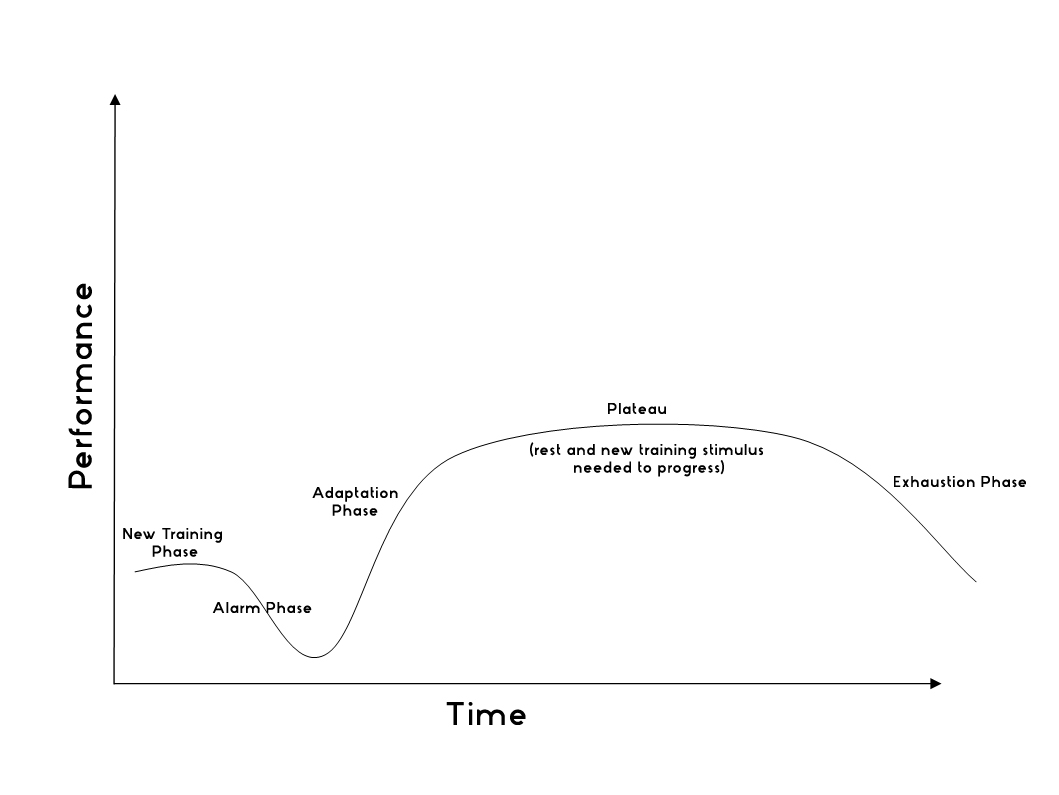
And actually it’s those dips that make you grow. What happens is the adaption process. And this is how it works:


The Stimulus

This is your new training routine or you come back after months or years of not training.

And even if you have always been training when you start a new, intensive routine, that’s the stimulus that starts the adaptation process.


The Alarm Phase

The alarm phase follows the beginning of your training routine, or a new training routine, the initial stimulus.

This is where you feel you’re not going to make it. It’s difficult to push through. But that’s also when the adaptations in the nervous system occurs. It’s the first stage of adaptation.

Any stimulus will initially lead to a decrease in performance in the alarm phase. And this phase can last for days or weeks. During this period, you may experience fatigue, stiffness and soreness and a temporary drop in physical performance. Some confuse this with over training. Nope, that comes later and only if you keep doing the same things without changing anything, there are certain conditions.

The alarm phase is a must as without it we would not have the next stage, the adaptation phase. You must go through the alarm phase.

By the way, this is when most people give up. Whether we talk about a new diet, lifestyle or training routine, when the tough gets tough here’s where most give up. But if you push through it you reach the next stage.

women running

The Adaptation

If you “survive” the alarm phase adaptations begin to occur.

This is where your nervous system has adapted and you begin to notice muscular and aerobic adaptions. This is progress in performance.

There are also skeletal adaptations taking place and that is why it is essential not to grow the muscle mass too much too fast, to allow the skeletal changes to take place as well. Otherwise it will lead to joint damage. Slow progress is the best. It’s about building strong foundations first.


The Plateau

We’ve all heard about the plateau. You know, when you adapt to a certain routine and you stop making progress, or make very small progress.

It’s part of the adaptation process and unless you give the body another routine, to stimulate adaptation again, it will only be a maintenance program. You’re not getting anywhere when you hit that plateau.

Furthermore if you stay for too long in the plateau your performance will slowly begin to decrease as you reach the exhaustion phase which can lead to over training. This is where over training can occur.

This is where you need a scheduled break. By break I mean you either do a type of training like balance and fluid movement or do a different sport like swimming if you are a runner. You don’t just stop for a few weeks and do nothing at all.


The Exhaustion Phase

This is critical. You see so many gym enthusiasts doing the same routine for months, some even for years without changing much or anything at all.

Continuous exposure to the same routine, or stimulus, will eventually lead to overtraining. This is due to the inability of the body to tolerate the cumulative stress of the same stimulus over a period of time.

This is why I always say variation is key.

The exhaustion phase is characterised by a decrease in physical performance, as well as monotony, soreness and fatigue.

So the aim is to keep the body in the adaptation phase as long as possible. And to do this you need:

– periods of rest scheduled into the programme – remember rest doesn’t necesssarily mean you sleep all day and do nothing

– stimulus to be changed on a regular basis


This is how the process looks:

adaptation.

Technical Plateau

This is an element of the plateau which although it is not part of the adaptation process it’s something I’ve experienced in my athletic career and as a coach. And I’ve seen it in other sports people as well. Or rather heard about it.

The technical plateau is when you feel you just can’t get it right. You are still making progress in terms of adaptations, as we discussed above, but technical wise it feel weird and unusual. You just can’t get it right no matter how much you try. It’s like you have just lost your mojo, you know what I mean?

This is normal. It’s similar to the alarm phase. And what follows the alarm phase? Yep, adaption and progress. At some point you just get it right and it feels perfect.


So what do you do when you feel like you’ve lost your mojo?

1. Have patience

2. Focus on the process, on your training regime,  rather than on how things are not working out right that moment. Do your very best.

3. Have a coach, who can tell you what’s happening and who has been and/or goes through similar experiences and is familiar with the 4. phases. I believe a coach should go through all the stages themselves to be able to guide others through them.

4. Know that, if you coach says your techniques is fine, you are just in a dip and when you come out of it, in a few days or weeks, you will witness great progress.

5. Vary your training. For example I look to do something else than Karate, like Obstacle Racing. When you train and focus too hard on one thing, in my case the World Championship, you stretch yourself too much. You stretch like a rubber band and there so much a rubber band can stretch. It needs a bit of slack as some point.

I’ve been an athlete since 1995. Can you imagine how many adaption processes I went through? And they are never the same. But it’s beautiful to come out on the other side and see the massive progress. And this also helps me understand the different phases my clients go through and I am able to guide them accordingly


The same process applies to a new diet, implementing habits in your life, getting a new job, becoming an entrepreneur, moving from one country to another. You go through the initial alarm phase, adaptation and then plateau.

In terms of diet and healthy habits however, you want to reach the plateau, that’s where it gets comfortable and your body has adapted to the new types of food and new habits. Simple right?

Now that you understand how it all works you will not give up after a month or two of training or trying something new right? You know you are going through the alarm phase.

Are you going through any alarm phases or plateaus and not sure how to get through them? Are you stuck? Book a FREE call with me and let’s see how you can get through it.

Why I Am Not A Personal Trainer

Why I Am Not A Personal Trainer


Who would have thought that the knowledge about the body learnt after thousands of hours spent in the Dojo training for Karate competitions and teaching will be the foundations of my coaching today.

Everything from breathing, posture and meditation to developing a strong, flexible and healthy body as well as knowledge about bones, tendons and muscles were ingrained in me from an early age. All I needed to do is fill in the gaps through studying and experimenting on myself and form a complete system: The Merisoiu Technique.


So why am I not a Personal Trainer?

I was a PT for the beginning of my career in the health and fitness industry. As a PT I used to help my clients lose weight, tone up, get fit, gain muscle mass as well as nutritional advice.

I loved it. I loved it until I realized that I had so much more to give my clients. And I wasn’t. I couldn’t give what I wanted and the way I wanted. I wanted to transform my clients’ lives by addressing the foundations and personal development.

Now as a Coach I not only help my clients with their physical appearance and wellbeing but change the way they live their lives.

I don’t coach my clients to get fit and healthy for the summer, I coach them to be fit and healthy for the rest of their lives. And we do it by addressing the root cause of their imbalances and slowly changing habits, starting with the smallest ones.

My clients leave my programs with a lot of knowledge about their bodies and how they function. They receive intrinsic knowledge which they cannot learn from a book. This comes from years and years of experience. In essence it’s a Personal Development journey.

I wanted to introduce my clients to a new way of living life. So I transitioned from Personal Training to Transformational Coaching…outdoors

[tweetthis]I wanted to introduce my clients to a new way of living life.[/tweetthis]

Alexandra Merisoiu Shotokan Shield Open Karate Championships

The roots of The Merisoiu Technique

So when I created the system, The Merisoiu Technique, it was because my clients wanted to get fit, strong and powerful. However they also needed to understand how their bodies function, how to move soft and fluid and how to prevent injury as much as possible. And it was essential not to sacrifice the later for the former.

It was imperative for them to understand the difference between tension and relaxation, intentional movement, posture and balance and counterbalance. The Mindful Control component is where my clients learn to bring together or to align body, breath, and mind. And then to catapult their results we brought in the physical and psychological benefits and the freedom of training outdoors all year round. Benefits such as strength and emotional balance. And of course the nutrition and healthy habits part.

Finally, it became clear that my clients needed to have access to a complete system which would offer them the foundations they needed to live a healthy and fit life for the rest of their lives. Once you understand the basics of movement, posture, breathing, nutrition and Mindful Control then you actually become in control of your own life, for the rest of your life.

All in all The Merisoiu Technique involves coordinated movement, breath, and awareness, building a strong and fit body and learning how to implement healthy habits and nutrition. It’s about building the foundations of a healthy lifestyle and reclaiming your nature.

Alexandra Merisoiu Watch Fit

The principles of The Merisoiu Technique

The Technique covers five main areas of health and wellness:


Earthing

It is no coincidence that The Merisoiu Technique is an outdoors system of Personal Development which takes place all year round, be it hot, cold, freezing or rain.

I believe nature is the most powerful force. And when you train with natures elements you become as powerful as the elements. Well…almost as powerful. It’s perfection to strive for. However they do make your stronger than you have ever thought you could be.

One of the elements of The Technique that many are afraid of is rain and winter training. What many don’t realize is that this is your challenge, this is what shows how dedicated you are to the way, the path you chose.

And this is when you strengthen your body and mind, more than in any other season. Winter is the season of breakthroughs for all my clients. You make it through winter training with me, you make it through almost anything else.


Natural Movement

Natural movement was created by Movnat Founder Erwan LeCorre. It’s training and conditioning the body through movement such as lifting, throwing, hanging, crawling, balancing, running, walking. So you will find natural movement element in this system as well.


Fluid Movement

I have personally development a range of fluid movement sequences based on my experience in Martial Arts. Imagine Tai Chi but different.

Fluid movement can be done very slow, slow, fast or very fast, it can still flow. The Merisoiu Technique fluid movement sequences covers all.


Mindful Control

Here we pay close attention to posture awareness, breathing mastery, attention and focus, technique and discipline.

This component also includes mindfulness and meditation practices.

There is a touch of Alexander Principles in the Mindful Control component


Habits Transformation

This component addresses any habits in your life that keep you from getting fit and healthy for life.

In general, with my client, we focus on nutrition,  food discipline, individual training routines planned weekly and meditations.


So you see, this is a complete system. It pays close attention to every detail of your life. From breathing to posture and daily movement.

Your training never ends in the forest we train, it goes beyond. You take this knowledge home with you and you transform your life. What I was doing as a PT could not be taken home, it was left in the gym and it was changing your body but it didn’t go much further than that.


If this sounds like something you desire I invite you to book a FREE call with me to go over the struggles you are facing and see what are the best options for us to work together.

5 Awesome Benefits Of Sleeping On The Floor

5 Awesome Benefits Of Sleeping On The Floor


This is something I have never talked about and very few of you know that one of my greatest pleasures is sleeping on the floor. The earth and grass and perfect but if it’s a nice straight wooden floor that’s even better.

But what are the benefits of sleeping on the floor? Here are 5 benefits that come with it:

 happy

1. You can truly “let go”.

Because there is nothing there to take the shape of your body, your body cannot sink into the mattress, so you don’t need to tense up, you can actually relax and let go of tensions in your body.

2. Reduces lower back pain.

As the spine straightens and lengthens you get that feeling of release in your lower back and throughout your spine.

3. Aligns hips.

So many issues come from misaligned hips or pelvis, imbalanced muscles and body, poor posture and misaligned bones can also trap nerves. A straight wooden floor can realign the hips.

4. Aligns shoulders.

Misaligned shoulders can put strain on your neck and back, causing chronic pain, and even headaches. The consequences of a misaligned body take time to show up but it’s the details that many ignore which cause the greatest injuries. A straight wooden floor is perfect to realign the shoulders.

5. Posture.

You cannot achieve a nice lengthened posture if the pillow or mattress takes the shape of your head and body. It means that if your head and neck are in a wrong position they will take that shape and will keep your posture in the same (incorrect) position.

A wooden floor, if sleeping on the back, will align your head, neck, spine, hips, the whole body. The communication between head and the rest of the body is enhanced helping healing, improving circulation and better functioning of the body.

Remember that sleeping is the body’s natural way of healing, so sleep in a good resting position to enhance the process of healing.

A good posture also tells your brain it is happy while slouching tells your brain it is unhappy and sends stress signals towards your brain.

Thus by simply aligning our physical body we tap into mental wellbeing, happiness and optimism. Laying on the floor, on your back, makes things very easy, you don’t even have to think about it, you just need to enjoy the moment.


Other awesome benefits include grounding, less tossing and turning, falling asleep immediately, waking up earlier and there’s this feeling of clear mind that I always experience when I sleep on the floor. But that comes down to you to experiment and experience it for yourself.


How should I sleep on the floor?

The best position for most people is on their back. That’ll help align the body. On the side….not that much. Even if you say you cannot sleep in that position, on your back, you might be surprised at how much and how fast you relax and end up sleeping like a baby.

Of course as with anything else in the world there are also disadvantages but you just have to decide whether this works for you or not.


Won’t my body ache?

It might, at the beginning, if you’ve never slept on the floor or haven’t in a while. The body positions itself in a different way and joints straighten so if you do feel achy that might not be that bad. It might take up to one week for your body to adapt. However if you feel very uncomfortable start slow.


How should I build up so I don’t ache too much?

As with every habit it is good to start small. Just lie on the floor for 10-20-30 min or for how long you want before you go to bed or throughout the day. It may take up to a month to slowly build up. It depends on your body and its structure. You will know when you can sleep on the floor all night. Your body will let you know.


Warning!

If you have any injuries, skeletal problems or anything that sleeping on the floor might make worse do check with your doctor so you don’t create more damage.

Please keep in mind that this article is for information only, based on personal research in biomechanics and different therapies and personal experience. The author cannot take responsibility for any consequences if you decide to follow any of the advice in this article or on this website for that matter.


3 Ways To Design Your Environment And Make Exercise Easier And Enjoyable

3 Ways To Design Your Environment And Make Exercise Easier And Enjoyable


Developing the habit of exercising regularly can be difficult for some. For others it may be easier to start with but when they hit the plateau it gets really difficult to keep going. What’s your challenge?

There’s a thing you can do to make life easier for yourself. That’s designing your environment in the right way.

From experience I can tell you that waking up at 5 am 6 days a week to go running, followed by work (I worked in corporate banking back then) and then to courses (Masters in International Business) can sometimes be very difficult.

However not matter how difficult it gets you need to push a little bit through it otherwise you end up at the beginning and have to start all over again.

So here are 3 tips to think about when designing your environment for success.

woman-running

3. Use triggers

I wrote about triggers in more detail in another blog, right here.

Triggers are habits you do automatically without thinking too much about them. Like brushing your teeth in the morning and before you go to bed. Or pushing the right pedals when you drive, you don’t think about it anymore.

Triggers can also be for example when your kids come from school or when the alarm sounds in a certain way.

Choose a special ringtone for when you have your running days, you will set your brain to activate when it hears that particular ringtone and you will jump out of bed and run out the door.

These are triggers you can use to get you up and running, literally.


2. Make a list

Depending on the type of exercise you go for you will need different kit and accessories. Make a list of what you need.

I used to have a list for Karate class, one for running in summer, another for running in winter, at night or on rainy days and others for whatever other types of activities I was doing.

I’d have the lists on post-it notes and place them somewhere where I could easily see them without actually looking for them.

Make it easy and fast to prepare your training by making permanent lists and strategically placing them where you can easily see them.


1. Don’t wait until the last moment

Waiting to put your kit in your bag 5 min before heading to your outdoors session might just put you off.

Same goes for when you go for a run after work. When you arrive home don’t change into house clothing, change into your running kit straight away. Trust me it works like a charm.

Have everything prepared and ready to go.


Now you have 3 simple steps to make your workouts easier and less of a hassle: use triggers, make lists, and get everything ready beforehand.


Want a more personalized tips on designing your environment? Then book a FREE call with me and let’s get your triggers, lists and prepare you to enjoy your exercising days.

How To Use Triggers To Effortlessly Create Healthy Habits

How To Use Triggers To Effortlessly Create Healthy Habits


I love this part of Habits Transformation principles of The Merisoiu Technique simply because it’s like a game and it can be very creative and enjoyable.

Many clients who seek my guidance come to me struggling to reach a healthy or healthier lifestyle. Achieving a healthier lifestyle is just a matter of detail.

It’s the details make the whole so cutting out all your favourite foods and going to the gym 5 days a week all of a sudden will not necessarily work for building healthy habits leading to a healthier lifestyle.

Those details are tiny habits we overlook. Depending on how much my clients allow me to know about their lifestyle we address the smallest habits first. From there the big picture changes for the better as well.

One of the many ways I do this is by using triggers to create or transform habits.

driving

How triggers work

The triggers have to be habits which you automatically do without thinking about them. Such as brushing your teeth, food shopping or even walking, waiting at a red light or changing your clothes before going to bed.

So this is how it works. We take a trigger and associate a habit to it. Every time you do one thing the other one automatically follows.

For example:

– every time you wait at a red light you stand on one leg (if balance exercises are in your program)
– every time you brush your teeth you first do 5 squats (if moving more is a habit you want to build into your life)
– or every time you pour coffee in your cup you also pour water in a glass (if you need to build the habit of drinking more water)

These are simple examples yet the system works for any habit you want to create. And it makes things so much easier without getting you overwhelmed. You are probably busy enough just as it is.

However remember to take one habit and one trigger at a time. Trying to transform more than one habit will again lead to overwhelm.


Post your comments below with the habits you are trying to create and the associated triggers. I will give you some ideas to help you.

And if you need extra help please book a FREE call with me to discuss your current habits transformation journey and give you some idea moving forward.

9 Simple & Intuitive Approaches To Healthy Eating Habits

9 Simple & Intuitive Approaches To Healthy Eating Habits


When I think about my daily diet I always go back to when my grandmother used to cook for her grandchildren in the countryside.

No doubt that the food nowadays is not as nutritious as what my grandma used to have in her garden but it’s still up to us whether we make good or not so good choices when we decide what we are going to have for dinner.

So think about it, if you were in the countryside what would you have available in your garden and, if you eat meat, what kind of meat would you find around your house?

These are some ideas to get your creativity going.

1. Vegetables. Probably the fastest, easiest and most nutritious thing you can eat right from the garden picked up by yourself. You can cook them but you can also eat them raw. Vegetables have minerals and vitamins as well as some protein, fats and carbohydrates in some cases although in less quantities than meat or other foods.


2. Fruits. Have a sweet tooth? There are no supermarkets in your village. And to cook a dessert you will need a lot of other ingredients. Fruit are again an easy and nutritious way to satisfy your craving for sugar.

peppers

3. Water. Sure you might have a place to buy tea and coffee but what if you don’t? And you certainly don’t have the soft drinks you find in the supermarket. And you can’t be too picky either. You’d drink water more often in the countryside. We don’t have water as good as at my grandma’s but it’s still better than most other options.

About 71% of the Earth’s surface is covered with water. Your body is about 70% water. Thus water is life.

Remember to drink water throughout the day rather than gulping 1 litre in 10 min, give your body the change to take in and utilize the water.


4. Eating local, eating seasonal. Seasons happen in cycles and so are your bodies. You can’t rely only on certain sources of food all the time. Firstly because you’ll get bored of it but most importantly because you will not get the diversity of nutrients to nourish your body. Eating seasonal is a great way to explore various food options.


5. Have proteins with every meal. Yep, I remember that one very well. I ate meat but even when we didn’t have meat with our meal we had other types of protein. Although my grandma never knew what protein are she instinctively knew how to combine foods, similar to what we learn in our nutrition books. Amazing really.


6. Don’t deprive yourself from eating certain foods. Instead have them every now and then. Depending on the quality of the food you can think about having it every other week, once a month of even a couple of times a year like I do with homemade chips and pizza.


7. Cook it yourself. Oh yes, not more readymade meals or restaurant adventures. Good old home cooked food, with no sugars, additives, preservatives or unnecessary elements added just to give “the greatest taste”. Certainly sometimes you may need ingredients which have these things in them but you will not end up with a meal made of artificial colours for example.

It is also good to bear in mind here that for a food to taste good it needs fats and sugars. And when it has less of one it usually has more of the other. So watch out what your choices are.


8. Don’t eat until you can’t stand up anymore, even if it’s your favourite dish and you are very hungry. Stuffing yourself puts your digestive system under stress and you really don’t get much out of it. It takes about 7 seconds for the food to reach your stomach so give it time. Nourish yourself properly.


9. Eat mindfully. I left this one last because if there is one thing I want you to leave with is this. Eating mindfully has many benefits such as: better digestion, better extraction of nutrients from the food you eat, eating slower which helps you chew better and in turn helps your digestive system break down the food easier and with less stress, it will not have to overwork. It also contributes to weight loss and weight maintenance.


These are 9 of my many habits for a healthier and more meaningful eating. Keep thinking what and how would you would eat if you were in a village and eating healthy will suddenly become automatic, you will not need to think about it anymore.

I have written a blog on mindful eating, “3 Steps To Mindful Eating And Its Benefits”, to read it click here.

This is something I teach in my program. To sign up click here


The Secret To Creating Healthy Habits That Stick Long Term

The Secret To Creating Healthy Habits That Stick Long Term


You are a bundle of habits. Your life is governed by habits whether you acknowledge and accept that or not.

From the first thing you do when you wake up (open the curtains or brushing your teeth first) to the route you take to work, where you buy your coffee from, where you place your coffee on your desk, even the traffic light where you cross the street.

 business-woman

Every habit has its purpose

Every habit, healthy or not, has its purpose in the body. Your brain uses those habits to solve something.

It doesn’t make the difference of whether they are healthy for the body or not, it just knows that a certain “thing” will help it solve a given problem.

For example emotional eating. Usually emotional eating involves high sugar or another form of high carbs foods. Your brain struggles and sugars are the way it deals with the struggles, because you gave it this option in the past. Your brains learnt fast and now it asks for sugar or another forms of carbohydrate to solve a similar problem.

Same goes for smoking when stressed. Your brain learnt that smoking calms it down. So it asks for it.

Running can be another example. Many people use running as a stress relief, or to “run away” from their problems. This is a healthier habit nonetheless is can turn into a destructive one.

But I will not talk here about how you can take these habits out of your life. There is a step by step process I teach in The Merisoiu Technique Home Study Program which you can sign up for here.


Change vs Transformation

Before we talk about changing, transforming or creating anything let’s make the difference between change and transformation.

Change implies that what was before was totally wrong and it needs to becomes something else. When you change something the past is suddenly wrong.

On the other hand transformations come from the inside. Here you design your future and work towards it. Transformation is about changing beliefs not just working at the surface. Because it’s more fundamental, transformation is more likely permanent.

If you’d like to read more on the topic please download my ebook. I go into more detail there.


How to transform habits

When you attempt to transform your habits your brain will get confused and try to resist it. But there are ways to work around it so your brain and body respond in a favourable way.

As I said I have a step by step process I teach. Here I will give you 3 of those steps:

#3. Start small and go slow

You need to approach habits transformation it slowly so your body and brain adjust comfortably.

For example in nutrition I like to take my time with my clients, where possible. If I want them to eliminate bread from their diet I start with taking out a slice. Then wait for the body to adjust, then make another adjustment, then wait again.

It’s veeeery slow but it works so well. The changes are so small that there is no disruption in the system.

And most importantly I believe, they learn how to approach other habits in the future when I will not be there. This is empowerment, the foundations of my teachings.

#2. Focus on ONE thing at a time

Trying to tackle 10 things all at once will lead to overwhelm. There are too many things to think about.

Start with ONE thing. Usually one small alternation to your habits follows another and another and another. It’s like a snowball effect.

Simple example. When you workout you tend to eat healthier. Workout one day a week for 2 weeks, then go up to 2 and, with time, you will train 5 days a week and eat healthy 5 days a week as well. Then you also have 2 cheat days.

Boom! You only needed to start training once a week then everything else came by itself.  Simple

#1. Accountability

I believe this is among the most important steps in habits transformation. Why? Because of several reasons:

1. you don’t need to think about everything by yourself
2. there is someone you need to report to so you will feel bad if you come with a bad report every single time
3. when things get really tough there is someone there to let you know you are on the right track. You are motivated and know that someone has your back
4. you don’t need to know everything, someone else already has the knowledge and is willing to share it with you


This is how I work with my clients on the Home Study Program. They have all the training in terms of nutrition, exercising, personal development, healthy habits etc and they have someone there, myself, to guide them through the whole process.

If you’d like to learn more about how you can work with me please email me at alexandra@urbanwomenfitness.com

Weight loss is simple…

 Weight loss is simple…


Ha, I knew this will draw your attention.  But I am serious, it is simple. If you struggle with weight you might say this is nonsense. But hear me out, read the whole thing including my story at the end. Read with an open mind.


Weight loss is simple, keeping it off is bloody difficult. You can lose weight fast in so many ways including going day and night to the gym for an X number of months, stop eating carbs and fats, being “beasted” into running and weight lifting, pills and shakes and all other stuff.

tape-403590_1280

But what happens when all this stops?


Because you can’t do this forever. You know why? Well….you will be miserable because you want to live your life, you only have one after all, and it’s short. So you want to enjoy it not feel you are trapped in your own body.


You want to eat a biscuit from time to time, you want chips now and then , you want to have an ice cream once in a blue moon, because they are tasty, your brain is thankful, you are enjoying life.


So after you lose the weight and start living your life with pleasure again, even if that means you will have an ice cream once a year, what will happen?


I’ll tell you what will happen. After you put your body and brain under so much pressure to avoid fats and carbs and everything else, when they finally get some they will hold on to it thinking they will probably not get any more because that’s what you taught them.


And every time you eat something you “shouldn’t” your body will keep it all.


So what is The Secret to losing weight and keeping it off


Oh the secret….there’s no secret. Sorry to disappoint you. Harv Ecker said in a video that doing SIMPLE THINGS on an ongoing basis will change who you are.


Yep, I’m sorry again, but to get the weight off and keep it off you need to look for simple things and do them on an ongoing basis. Don’t worry, they will become automatic and you will not struggle with them after a while. But you should look for simple things anyway, so you don’t struggle.


Weight loss is a result of a healthy lifestyle and a healthy lifestyle has several components: Body, Mind, Emotions, Soul and Social.

If and when you understand this, really understand it, that’s when you will get your weight loss with a lot less resistance.

But focusing on weight loss alone will get you nowhere, and you will end up slim, sad and miserable.

stamp-143799_1280

Here’s what I mean by simple things which you do on an ongoing basis that will change who you are:


Simple Thing #1. Eat healthy


You heard me saying it before and I say it again.


Understand that weight loss and weight maintenance is the result of a healthy life. And that means eating food how mother nature gives them to you (95% of the time at least, exceptions are allowed). That’s fats, carbs, protein, vitamins and minerals. Everything that’s in the books.


Simple Thing #2. Exercise a little


Walk, run, practice a sport, 15 – 30 min a day 4-5 days a week. If now you walk everyday and you don’t lose weight that means your body is ready to take exercising at the next level, maybe a run or maybe longer or/and faster walking.


Or maybe searching and finding a sport you like instead of going to the gym if you don’t enjoy it that much. Or how about spending more time outdoors?


Simple Thing #3. Be happy, be grateful

This is emotional and spiritual health.


See the small beautiful things in life, because they are everywhere. I used to be happy collecting dried leaves in autumn and I love feeling the texture of a tree bark. Yep….now you know. I am a tree hugger…..as if you didn’t already know… The fact is that it does not take a lot to make me happy.


These are simple things you can do on an ongoing basis. Easier said than done….I know very well what you mean.


The fact is that  to do this you need to create space in your mind and in your life so you can see clear and make wise decisions.


And that’s when I come into the picture. I create a healthy, fit and organic lifestyle for my students which they learn to keep by themselves, which stick long term. That’s empowerment, so they achieve and keep and improve their achievements. And I invite you to book a free call with me to go over some of your struggles and find solutions (yes, FREE COACHING on this call!!)

Be consistent, keep going…and going

Something done over 3 days will be a waste of your time. Done over 3 months will do nothing. Done over 1 year will get you nowhever. A simple habit done over 3-4 years will literally change who you are.


This is continuous development. Consistency is key when we want to continuously grow and improve, whether we talk about weight loss and maintenance or being a top athlete. Consistency, even if it’s slow and steady, they trick is to keep at it.


And that’s what my business mentor Amanda Watts keeps repeating and repeating hoping we will all get the picture at some point.


My personal experience with weight loss


And I tell you this from personal experience. Yep…..even since I took a break from Karate I always had problems keeping a balanced weight.


When I was around 18 I was 10kg heavier than today, maybe even more. And that’s because I stopped karate (after 10 years of being in the National Squad) and for 2 years I didn’t do too much sport or physical activity. And I had a friend who was not interested in these things.


And we used to eat junk food and all sorts of crap (pardon my language), day and night. Since that unbalance I experienced weight gain and weight loss throughout the years.


When I started running, in 2 years I became so addicted to it that I went down to 49kg and people thought I was malnourished. Then I slowed down on running and weight went up to my balance point which s 51-53kg. But then it went  again to 59kg and down again and so on so forth.


So the way I have maintained my weight balanced throughout the past few years is by following some simple actions and doing them on an ongoing basis. And 3 of them are in this article. It’s as simple as that.


And I enjoy life and food, I have ice cream every other month, and sometimes I have milk chocolate as well and bread, and pizza once or twice a year, same with home made chips.


And I am happy and healthy, and I am not miserable that I can’t eat this and that. And instead of saying I’m not allowed to eat this and that, my mindset was always that I choose not to eat them, and I choose when to have them.


Weight loss is a result of health and not the other way around

…and a healthy life consists of healthy habits. But to transform your current habits you need to go through a step by step process that’s as little painful as possible. But I am here for you, book a free call with me and I will work with you on a couple of habits to get you on the right path.

How to easily create healthy habits that stick long-term

How to easily create healthy habits that stick long-term


Our life is made out of a bundle of many habits. Just think about it, you brush your teeth every morning – habit, you drink your coffee/tea every morning, you lock the door, drive to work, change your clothes when you go to bed, that’s a habit as well. Almost everything we do is a habit, and a habit is automatic and painless.


When you want to improve productivity, focus, reduce stress and be healthier but you struggle, there is nothing better that creating and nurturing a good habit, which comes automatic, it’s fast and easy.


However, to create a habit is easier said than done right? Well, don’t jump to conclusions, there are ways to easily create and maintain a habit for a long time, to make it part of your life routine.


Before you continue, chose a habit you’d like to create, whether it is health and fitness related, business or personal.

These are 3 of the steps I take my clients through when we have a habit we want to create transform as part of The 6 Guiding Principles of a Healthier Lifestyle:

project

1. Start small

It is important not to just throw yourself into something new. Your body and brain need time to learn the new habit, it’s a change for them. It’s like jumping into ice cold water when you’ve never even experienced a cold shower. It’s all about adaptation.

Let’s say you want to go for a run 5 days a week for 1 hour. Start with a run 1 day a week for 30 min, or even 10 min. After 4 runs, go up to 2 runs a week or stay with 1 a week but add 5-10 more minutes. Simple and painless.

You will see how easy and comfortable you build this habit and stick to it.

You can apply this even in an office environment or personal goals.


2. Focus on the tasks

When you make tasks part of your daily routine, you build a habit that sticks. Instead of focusing on the end goal, create many small daily or weekly tasks which lead to the end result. Then you only need to get those small, fast tasks done, to tick them off the list. That’s it, slowly building to the end result.


3. Design your environment for success

Why make life difficult for yourself? Design your environment so it helps you with your tasks and ultimately your goal or habit.

For example, let’s say you want to take trash out every Friday morning when you leave to work at 5 am. Why not place the bag in front of the door an evening before so at 5 am you don’t run around the house for the bin bag. You will have to pick it up to open the door (if you want to leave the house of course). You will build the habit of taking the trash out every Friday morning.


Again, you can apply this to anything you do, whether you want to create a new habit or to changing a habit

Want to go for a run first thing in the morning? Then get your kit ready next to your bed.

Want to have your own home cooked lunch at work? Prepare something the day before and put it in a plastic container ready to just throw it in your bag. Put a note on the front door so you don’t forget to take it with you.


All simple and painless.


Do you have a habit or tasks you want to implement into your life? Try these 3 steps and let me know how it works out for you.