This Is Why You Feel You Are Not Making Progress

This Is Why You Feel You Are Not Making Progress


The reality is we all go through them. You know, the dips. Those moments that can last for days and weeks, where you feel you’re not getting anywhere, you just want to kinda “take your toys and go home”. You feel you’re not making any progress, or even worse you feel you are regressing!!

What a horrible feeling! Especially when you work really hard to get those results.

But you know what, if we didn’t have those dips we would never see any progress in the first place, in anything. Whether it’s training, or a new diet or a change in lifestyle habits, or even building a business and a brand, believe it or not. Entrepreneurship takes you through the same process.

And actually it’s those dips that make you grow. What happens is the adaption process. And this is how it works:


The Stimulus

This is your new training routine or you come back after months or years of not training.

And even if you have always been training when you start a new, intensive routine, that’s the stimulus that starts the adaptation process.


The Alarm Phase

The alarm phase follows the beginning of your training routine, or a new training routine, the initial stimulus.

This is where you feel you’re not going to make it. It’s difficult to push through. But that’s also when the adaptations in the nervous system occurs. It’s the first stage of adaptation.

Any stimulus will initially lead to a decrease in performance in the alarm phase. And this phase can last for days or weeks. During this period, you may experience fatigue, stiffness and soreness and a temporary drop in physical performance. Some confuse this with over training. Nope, that comes later and only if you keep doing the same things without changing anything, there are certain conditions.

The alarm phase is a must as without it we would not have the next stage, the adaptation phase. You must go through the alarm phase.

By the way, this is when most people give up. Whether we talk about a new diet, lifestyle or training routine, when the tough gets tough here’s where most give up. But if you push through it you reach the next stage.

women running

The Adaptation

If you “survive” the alarm phase adaptations begin to occur.

This is where your nervous system has adapted and you begin to notice muscular and aerobic adaptions. This is progress in performance.

There are also skeletal adaptations taking place and that is why it is essential not to grow the muscle mass too much too fast, to allow the skeletal changes to take place as well. Otherwise it will lead to joint damage. Slow progress is the best. It’s about building strong foundations first.


The Plateau

We’ve all heard about the plateau. You know, when you adapt to a certain routine and you stop making progress, or make very small progress.

It’s part of the adaptation process and unless you give the body another routine, to stimulate adaptation again, it will only be a maintenance program. You’re not getting anywhere when you hit that plateau.

Furthermore if you stay for too long in the plateau your performance will slowly begin to decrease as you reach the exhaustion phase which can lead to over training. This is where over training can occur.

This is where you need a scheduled break. By break I mean you either do a type of training like balance and fluid movement or do a different sport like swimming if you are a runner. You don’t just stop for a few weeks and do nothing at all.


The Exhaustion Phase

This is critical. You see so many gym enthusiasts doing the same routine for months, some even for years without changing much or anything at all.

Continuous exposure to the same routine, or stimulus, will eventually lead to overtraining. This is due to the inability of the body to tolerate the cumulative stress of the same stimulus over a period of time.

This is why I always say variation is key.

The exhaustion phase is characterised by a decrease in physical performance, as well as monotony, soreness and fatigue.

So the aim is to keep the body in the adaptation phase as long as possible. And to do this you need:

– periods of rest scheduled into the programme – remember rest doesn’t necesssarily mean you sleep all day and do nothing

– stimulus to be changed on a regular basis


This is how the process looks:
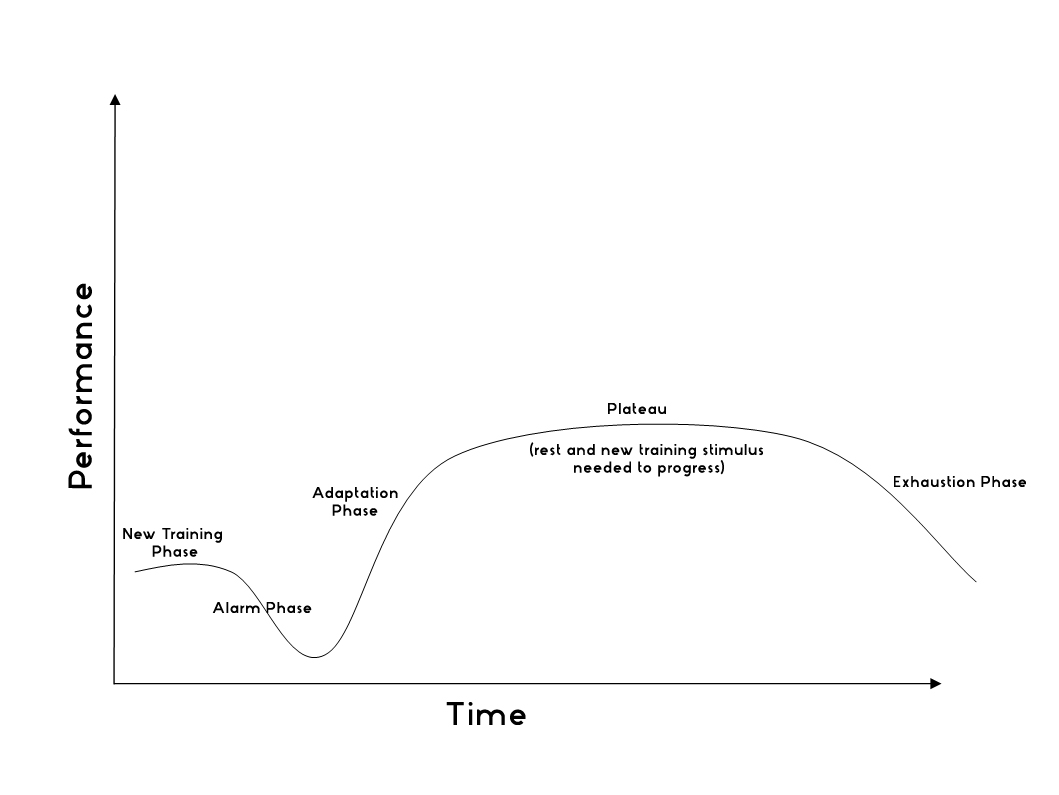
adaptation.

Technical Plateau

This is an element of the plateau which although it is not part of the adaptation process it’s something I’ve experienced in my athletic career and as a coach. And I’ve seen it in other sports people as well. Or rather heard about it.

The technical plateau is when you feel you just can’t get it right. You are still making progress in terms of adaptations, as we discussed above, but technical wise it feel weird and unusual. You just can’t get it right no matter how much you try. It’s like you have just lost your mojo, you know what I mean?

This is normal. It’s similar to the alarm phase. And what follows the alarm phase? Yep, adaption and progress. At some point you just get it right and it feels perfect.


So what do you do when you feel like you’ve lost your mojo?

1. Have patience

2. Focus on the process, on your training regime,  rather than on how things are not working out right that moment. Do your very best.

3. Have a coach, who can tell you what’s happening and who has been and/or goes through similar experiences and is familiar with the 4. phases. I believe a coach should go through all the stages themselves to be able to guide others through them.

4. Know that, if you coach says your techniques is fine, you are just in a dip and when you come out of it, in a few days or weeks, you will witness great progress.

5. Vary your training. For example I look to do something else than Karate, like Obstacle Racing. When you train and focus too hard on one thing, in my case the World Championship, you stretch yourself too much. You stretch like a rubber band and there so much a rubber band can stretch. It needs a bit of slack as some point.

I’ve been an athlete since 1995. Can you imagine how many adaption processes I went through? And they are never the same. But it’s beautiful to come out on the other side and see the massive progress. And this also helps me understand the different phases my clients go through and I am able to guide them accordingly


The same process applies to a new diet, implementing habits in your life, getting a new job, becoming an entrepreneur, moving from one country to another. You go through the initial alarm phase, adaptation and then plateau.

In terms of diet and healthy habits however, you want to reach the plateau, that’s where it gets comfortable and your body has adapted to the new types of food and new habits. Simple right?

Now that you understand how it all works you will not give up after a month or two of training or trying something new right? You know you are going through the alarm phase.

Are you going through any alarm phases or plateaus and not sure how to get through them? Are you stuck? Book a FREE call with me and let’s see how you can get through it.

Why Weight Loss Should Not Be Your #1 Priority

Why Weight Loss Should Not Be Your #1 Priority


Before I even begin to write on the topic I want to tell you my story on weight loss, or rather weigh gain.

Until not long ago I was about 10 kg heavier than how you see me now. That’s almost 2 stones and I am sure at some points I was 2 stones heavier than what I am now.

And let me tell you something. After you are an athlete training 6 days a week and eating whatever you wanted and whenever, drinking soft drinks , eating fast food and never putting any weight on, not even knowing what cellulite it, putting 10kg on brings you down like a rock in a lake. It’s really a shock.

Ok, so now you know I had to lose weight myself. Busted!

weighing

How gained weight in the first place

I took a break from Karate and for almost 2 years my physical activity went from 6 training session a week to 1….. maybe!

However my food intake was the same AND I started eating fast food and eating out with my friends as well as drinking soft drinks more than before.

#1 mistake: lack of physical activity

#2 mistake: junk food and eating out

#3 mistake: stressed out because of the extra weight and quality of food intake


How I got back to my normal weight


Habit #1

stop eating out, junk food, soft drinks, even sauces with my food.

My mother put me on a diet of grilled meat, salads, fruit and whatever else she thought I needed to nourish my body. Rice and potatoes once a week, maybe twice. Bread …..not really. Pasta never, we are not pasta lovers.

My mother is a diet genius I tell ya! She helped me lose the weight and keep it off. Would you like a consultation with her ? :)) Ah, sorry to disappoint you but you are stuck with me.


Habit #2

Stop spending time with friends so often and start training and running. That’s when I fell in love with running, 7-8 years ago I think.


Habit #3

Stop thinking about losing weight. And this is THE SECRET. Allow me to elaborate on this idea.

Focus on losing weight and it will become the most difficult thing in the world. That’s because it takes time.

You have ups and downs and it’s so easy to get demoralized when you see the scale showing you lost weight today and next week you are 1kg heavier. Drove me nuts!

tape-403590_1280

This is why you should not make weight loss your #1 priority. Rather than making weight loss your priority focus on the process:

1. Eat healthy, unprocessed food. Find foods that are simple and grilled meat with fresh vegetable salads are a great starting point. Eat….more……salads!


2. Find a sport or type of exercise you like and can get better at. Where you learn something rather than just burn calories for the sake of burning calories.

Where you feel fantastic that today you managed to do that exercise you worked on for weeks. It’s exciting! And accomplishment.

Where you come with a smile on your face knowing you have no idea what you’ll be doing. It’s always a surprise.

Doing the same routine you did yesterday, the day before and last week will just make you feel like you’re not going anywhere. There’s nothing new, nothing exciting.

That’s why I love the outdoors and my clients love it as well, because every time you go out there you find something different.

Nature is never ever the same. And they learn what to do, why they do it and how to do it by themselves, they become their own mini coaches.

Of course training with me takes them out of their comfort zone, they learn more and so they make much more progress when coached.

And finally I spark creativity in them. I encourage them to allow their body to flow and be creative  rather than just go from 10 press-ups to 20 and then 30.


3. Have patience

It took me over 2 years to lose the weight I put on in less than 2. How long did it take you to put the weight on?

It may not take 10 years to lose weight you put on in 9 but it will not take 3 months either. That’s is if you want to keep it off.


Lose weight without trying

Awesome isn’t it? Losing weight without actually trying. Just by giving your body the nutrients and the fuel it needs through good nutrition and movement.

That’s what our body needs to function properly. And when it functions properly then it goes back to its original weight and shape. You weren’t born overweight.

Weight loss is easy, it really is, when you stop trying to lose it and just look after your body from the inside first. And have patience


As usual I am here to give you free motivation and inspiration through my blogs. But I know how difficult it is to take the first step alone. Even I had a coach, my mother that is. Believe me, it was like in the military. No love and cuddles, I was on a serious journey to re-gaining my balance.


How serious are you about your journey? Are you committed enough? Do you do what you are told to get the results you seek? Do you focus on the process?


Let me show you the path you need to follow to get from where you are to where you want to be. And I will show you this for FREE when you book a call with me.


We will go through you initial weight loss goal. Then we will talk about your diet and finally we will see what activity you can take on to stop you thinking about weight loss and just focus on the process. This takes less than 45 min. Book that FREE call with me and let’s go.


How nutrition affects our Mental Health

How nutrition affects our Mental Health


Although no one has ever seen the mind, we can consider the brain as the platform for the mind and thus a platform for out mental wellbeing.


The brain is made up in large part of essential fatty acids, water and other nutrients. We know that food affects how we feel, think and behave. You felt it , I felt it, everyone knows it. But how many of us, especially busy professionals take the time to invest in this knowledge which actually has the potential to make their businesses a success?


Most of your brain is derived directly from food. The last fifty years have witnessed remarkable alterations to what we eat, how we process and refined it, food additives, use of pesticides and the alteration of animal fats through intensive farming. And here we are thinking we actually eat healthy fats.


Studies estimate that the average person in the UK and other industrialised countries will eat more than 4 kilogrammes of additives every year!!! So the importance of reducing processed food as much as possible is critical. At least the obvious ones.


Different methods of farming have also introduced higher levels and different types of fat into our diet. Nowadays chickens grow twice as fast as 30 years ago and this changes the quality of the meat. A chicken carcass used to be 2% fat, it is now 22%. according to Dr Deborah Cornah, Consultant to the Mental Health Foundation


The chicken’s changed diets have reduced omega-3 fatty acids and increased omega-6 fatty acids in the meat.


Unequal intakes of omega-3 (fish and oils) and omega-6 fats (cereals, eggs, poultry) have been implicated in a number of mental health problems, including depression, concentration and memory problems. Scientists have observed that western diets contain far too much omega-6 and not enough omega-3.


Smoking, drinking alcohol, tea, coffee or eating chocolate, improves one’s mood, we all know this, at least temporarily. What we don’t know, or rather ignore, is that some foods can have a lasting influence on mood and mental wellbeing because of the impact they have on the structure and function of the brain.

sad-girl


Food and Depression


Evidence shows that the presentation of depression in the UK population has increased dramatically over recent decades, with more cases being reported in children, adolescents and young adults. And the only way we address it is through pills, to suppress the symptoms but not addressing the cause.


There seems to be a correlation between low intakes of fish by a country and high levels of depression amongst its citizens, as well as the reverse. This correlation has been shown for major depression, post-natal depression, seasonal affective disorder and bipolar affective disorder.


Complex carbohydrates as well as certain food components such as folic acid, omega-3 fatty acids, selenium and tryptophan are thought to decrease the symptoms of depression. Those with low intakes of folate, or folic acid, have been found to be significantly more likely to be diagnosed with depression than those with higher intakes.


Similar conclusions have been drawn from studies looking at the association of depression with low levels of zinc and vitamins B1, B2 and C.


In other studies standard treatments have been supplemented with these micronutrients resulting in significant relief of symptoms in people with depression and bi-polar affective disorder, in some cases by 50%.


In one epidemiological study it was found that levels of depression were rising at the same time that traditional diets were being abandoned for more processed foods.


Food and Schizophrenia


I don’t know much about Schizophrenia but according to the research out there, people with schizophrenia have lower levels of polyunsaturated fatty acids (oils made from seeds, corn, nuts, vegetables) in their bodies than those with no experience of illness.


There has also been evidence which suggests that antioxidant enzymes (found in orange

and red peppers, spinach and tomatoes.) are lower in the brains of people with schizophrenia.


Food and Attention Hyperactivity Disorder


If my parents were to ever take me to the doctor I would have been diagnosed with ADHD for sure. But they never did, they raised and nurtured and helped me develop in a traditional and healthy way as best they could. Most importantly they gave me the chance to use up all my energy through various sports. I didn’t spend too much time indoors eating and sleeping.


However, for more serious cases of ADHD, there have been great improvements when dietary changes are introduced to children with ADHD. Two food groups have been identified, fatty acids and minerals.


It seems that children diagnosed with ADHD commonly share characteristics of Essential fatty acid (Cereal, pasta, bread, vegetables) deficiency. A deficiency in zinc (red meat, beans and poultry) was also discovered among children with ADHD.


There is even more research out there linking diet with mental health is growing at a rapid pace. The quality of the food we eat has a great impact on feelings of mood and general wellbeing, but the evidence demonstrates its contribution to the development, prevention and management of specific mental health problems like the ones described above.

 salad-122722_1280


What can we do?


Balanced mood and feelings of well being can be maintained by ensuring that our diet provides adequate amounts of complex carbohydrates, essential fats, amino acids, vitamins and minerals and water in balanced amounts.


I encourage you to do your research so you make informed decisions rather than believe everything you are told. Read shorts articles on macronutrients and micronutrients and decide for yourself whether a type of food is good or not.

Educating our children is our number one priority. However instead of teaching by example we say something it not healthy and we still eat it. Kids copy adults’ behaviours and no matter how many times we tell them it’s not good they will still copy what we do. Lead by example, walk the talk.


If you’d like to learn more please download my free eBook “15 Healthy Habits For The Body”


Primary sources:
Feeding Minds: The impact of food on mental health by Mental Health Foundation
Diet and the effects on emotional wellbeing and mental health by Jonathan Stanley, National Children’s Bureau and National Center of Excellence in Residential Child Care.